Advertisements
Advertisements
प्रश्न
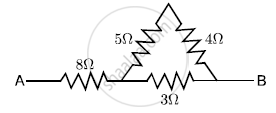
Calculate the effective resistance across AB?
Advertisements
उत्तर
5 Ω and 4Ω are in series
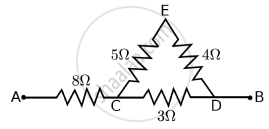
∴ R1 = (5 + 4)Ω = 9Ω
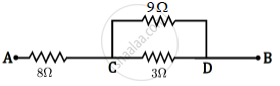
Now, 9Ω and 3Ω are in parallel
`therefore R_2 = (9 xx 3)/(9+3)=9/4Ω`
Now, 2 8Ω and R2 are in series
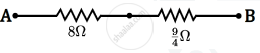
`therefore R_3 = 8 +9/4 =41/4 Ω= 10.25Ω`
APPEARS IN
संबंधित प्रश्न
What will be the change in the current if the potential difference is kept constant and the resistance of the circuit is made four times?
- It will remain unchanged.
- It will become four times.
- It will become one-fourth.
- It will become half.
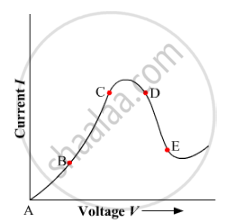
Graph showing the variation of current versus voltage for a material Ga As is shown in the figure. Identify the region of
(i) negative resistance
(ii) where Ohm's law is obeyed.
Will current flow more easily through a thick wire or a thin wire of the same material, when connected to the same source? Why?
- Name and state the law which relates the potential difference and current in a conductor.
- What is the necessary condition for a conductor to obey the law named above in part (a) ?
Define Current density.
The variable resistance is called ____________.
Suppose there is a circuit consisting of only resistances and batteries and we have to double (or increase it to n-times) all voltages and all resistances. Show that currents are unaltered. Do this for circuit of Example 3.7 in the NCERT Text Book for Class XII.
Let the resistance of an electrical device remain constant, while the potential difference across its two ends decreases to one fourth of its initial value. What change will occur in the current through it? State the law which helps us in solving the above stated question.
In which unit is the resistance of a conductor measured?
When two conductors at different electric potentials are joined by a metallic wire, in which direction do the electrons flow?
