Advertisements
Advertisements
प्रश्न
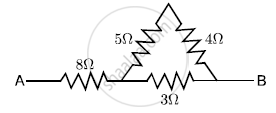
Calculate the effective resistance across AB?
Advertisements
उत्तर
5 Ω and 4Ω are in series
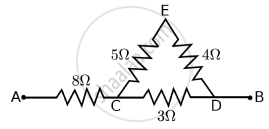
∴ R1 = (5 + 4)Ω = 9Ω
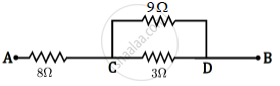
Now, 9Ω and 3Ω are in parallel
`therefore R_2 = (9 xx 3)/(9+3)=9/4Ω`
Now, 2 8Ω and R2 are in series
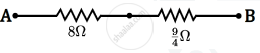
`therefore R_3 = 8 +9/4 =41/4 Ω= 10.25Ω`
APPEARS IN
संबंधित प्रश्न
What will be the change in the current if the potential difference is kept constant and the resistance of the circuit is made four times?
- It will remain unchanged.
- It will become four times.
- It will become one-fourth.
- It will become half.
The resistors R1, R2, R3 and R4 in the figure given below are all equal in value.
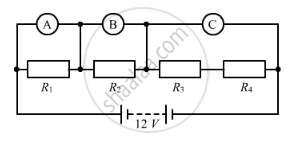
What would you expect the voltmeter A, B and C to read assuming that the connecting wires in the circuit have negligible resistance?
Calculate the current flowing through a wire of resistance 5 Ω connected to a battery of potential difference 3 V.
Tick(✓) the correct choice in the following:
Ohm's law is applicable to
- Name and state the law which relates the potential difference and current in a conductor.
- What is the necessary condition for a conductor to obey the law named above in part (a) ?
Define temperature coefficient of resistance.
The slope of voltage (V) versus current (I) is called:

Ohm's law deals with the relationship between ______
Two cells of same emf E but internal resistance r1 and r2 are connected in series to an external resistor R (Figure). What should be the value of R so that the potential difference across the terminals of the first cell becomes zero.
The electric current between two joined conductors at different potentials continues to flow until:
