Advertisements
Advertisements
प्रश्न
A low voltage supply from which one needs high currents must have very low internal resistance. Why?
Answer the following giving reason:
A low voltage supply from which one needs high currents must have very low internal resistance. Why?
Advertisements
उत्तर
According to Ohm’s law, the relation for the potential is V = IR
Voltage (V) is directly proportional to the current (I).
R is the internal resistance of the source.
I = `V/R`
If V is low, then R must be very low, so that a high current can be drawn from the source.
संबंधित प्रश्न
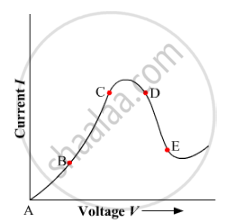
Graph showing the variation of current versus voltage for a material Ga As is shown in the figure. Identify the region of
(i) negative resistance
(ii) where Ohm's law is obeyed.
What is Resistivity?
How should the two resistances of 2 ohms each be connected so as to produce an equivalent resistance of 1 ohm?
What is an ohmic resistor? Give one example of an ohmic resistor. Draw a graph to show its current voltage relationship. How is the resistance of the resistor determined from this graph?
An electric bulb draws 1.2 A current at 6.0 V. Find the resistance of filament of bulb while glowing.
A car bulb connected to a 12 volt battery draws 2 A current when glowing. What is the resistance of the filament of the bulb? Will the resistance be more same or less when the bulb is not glowing?
In an experiment of verification of Ohm’s law following observations are obtained.
|
Potential difference V (in volt) |
0.5 | 1.0 | 1.5 | 2.0 | 2.5 |
| current I (in ampere) | 0.2 | 0.4 | 0.6 | 0.8 | 1.0 |
Draw a V-I graph and use this graph to find:
- the potential difference V when the current I is 0.5 A,
- the current I when the potential difference V is 0.75 V,
- the resistance in a circuit.
Consider the sacle of voltmeter shown in the diagram and answer the following questions :

(a) What is the least count of the voltmeter?
(b) What is the reading shown by the voltmeter ?
(c) If the voltmeter is connected across a resistor of 20 `Omega` how much current is flowing through the resistor?
- Name and state the law which relates the potential difference and current in a conductor.
- What is the necessary condition for a conductor to obey the law named above in part (a) ?
Define ampere and volt with respect to Ohm’s law.
Ohm’s law states the relationship between power and voltage.
Obtain the macroscopic form of Ohm’s law from its microscopic form and discuss its limitation.
Explain the equivalent resistance of a parallel resistor network.
The resistance of a nichrome wire at 0°C is 10Ω. If its temperature coefficient of resistivity of nichrome is 0.004/ °C, find its resistance of the wire at boiling point of water. Comment on the result.
Two cells each of 5V are connected in series across an 8Ω resistor and three parallel resistors of 4Ω, 6Ω, and 12Ω. Draw a circuit diagram for the above arrangement. Calculate
- the current drawn from the cell
- current through each resistor
Assertion: The statement of Ohm’s law is K = IR.
Reason: V = IR is the equation which defines resistance.
For a continuous current flow through a conductor, what must be maintained across the ends of the conductor?
Which of the following describes the V-I relation for an Ohmic conductor?
What is the nature of the graph obtained when potential difference is plotted against current for an Ohmic conductor?
