Advertisements
Advertisements
प्रश्न
A low voltage supply from which one needs high currents must have very low internal resistance. Why?
Answer the following giving reason:
A low voltage supply from which one needs high currents must have very low internal resistance. Why?
Advertisements
उत्तर
According to Ohm’s law, the relation for the potential is V = IR
Voltage (V) is directly proportional to the current (I).
R is the internal resistance of the source.
I = `V/R`
If V is low, then R must be very low, so that a high current can be drawn from the source.
संबंधित प्रश्न
The graph between V and I for a conductor is a straight line passing through the origin.
What should remain constant in a statement of this law?
How much energy is consumed when a current of 5 amperes flows through the filament (or element) of a heater having resistance of 100 ohms for two hours? Express it in joules.
- Draw a V-I graph for a conductor obeying Ohm’s law.
- What does the slope of V–I graph for a conductor represent?
Show by a diagram how two resistors R1 and R2 are joined in parallel. Obtain an expression for the total resistance of the combination.
In the circuit shown below in Fig, calculate the value of x if the equivalent resistance between A and B is 4 Ω.

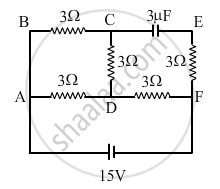
In the circuit shown in the figure, find the total resistance of the circuit and the current in the arm AD.
Define ampere and volt with respect to Ohm’s law.
What is non-ohmic resistor?
Which of the following I-V graph represents ohmic conductors?
The unit of specific resistance is ____________.
The temperature of a conductor is increased. The graph best showing the variation of its resistance is:
A current of 2amp flowing through a conductor produced 80 joule of heat in 10 sec. The resistance of the conductor is:-
Two cells of same emf E but internal resistance r1 and r2 are connected in series to an external resistor R (Figure). What should be the value of R so that the potential difference across the terminals of the first cell becomes zero.
What is meant by resistance of a conductor ? Define its SI unit.
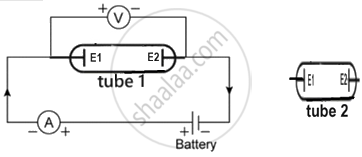
The circuit depicted in the figure is employed for studying Ohm’s Law. Instead of using a standard resistor, a student opts for a glass tube filled with mercury (tube 1), connected to the circuit through two electrodes, E1 and E2. He records the readings of the ammeter and voltmeter, thereby calculating the resistance. The student repeats the experiment by substituting tube 1 with tube 2, where the same amount of mercury fills tube 2.
Neglecting internal resistance of the cell use (> or < or =) to compare:
- the resistance in both the cases.
- the voltmeter readings in both the cases.
- the specific resistance in both the cases.
If a current of 1 A flows through a conductor, then according to Ohm's Law, the resistance of the conductor is:
