Science (English Medium)
Academic Year: 2025-2026
Date & Time: 20th February 2026, 10:30 am
Duration: 3h
Advertisements
General Instructions:
Read the following instructions very carefully and strictly follow them:
- This question paper contains 33 questions. All questions are compulsory.
- This question paper is divided into five sections - Sections A, B, C, D and E.
- In Section A: Questions no. 1 to 16 are Multiple Choice type questions. Each question carries 1 mark.
- In Section B: Questions no. 17 to 21 are Very Short Answer type questions. Each question carries 2 marks.
- In Section C: Questions no. 22 to 28 are Short Answer type questions. Each question carries 3 marks.
- In Section D: Questions no. 29 and 30 are case study-based questions. Each question carries 4 marks.
- In Section E: Question numbers 31 to 33 are Long Answer type questions. Each question carries 5 marks.
- There is no overall choice given in the question paper. However, an internal choice has been provided in few questions in all the Sections except Section A.
- Kindly note that there is a separate question paper for Visually Impaired candidates.
- Use of calculator is not allowed.
You may use the following values of physical constants wherever necessary:
c = 3 × 10⁸ m/s
h = 6.63 × 10⁻³⁴ Js
e = 1.6 × 10⁻¹⁹ C
μ0 = 4π × 10−7 T m A−1
ε0 = 8.854 × 10⁻¹² C2 N−1 m−2
`1/(4 pi epsilon_0)` = 9 × 10⁹ N m2 C−2
Mass of electron (me) = 9.1 × 10⁻³¹ kg.
Mass of neutron = 1.675 × 10⁻²⁷ kg.
Mass of proton = 1.673 × 10⁻²⁷ kg.
Avogadro’s number = 6.023 × 10²³ per gram mole
Boltzmann’s constant = 1.38 × 10⁻²³ JK−1
A wire is gradually stretched to make it 100% longer. Its resistance will increase by ______.
100%
200%
300%
400%
Chapter:
A closely wound long solenoid of self-inductance L is cut into two identical solenoids. The value of self-inductance of each small solenoid will be ______.
`L/2`
2L
3L
4L
Chapter:
Which of the following characteristics of electrons determines the current in the conductor?
Drift velocity only.
Thermal velocity only.
Both drift velocity and thermal velocity.
Neither drift nor thermal velocity.
Chapter:
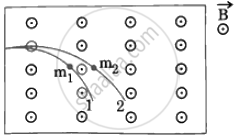
Two particles of masses m1 and m2 having charges q1 and q2 respectively are projected with the same velocity in a region of uniform magnetic field `vec B` pointing vertically upward. If they describe circular paths as shown in the figure, one may conclude that:
`m_1/m_2 > q_1/q_2`
`m_1/m_2 > q_2/q_1`
`m_1/m_2 < q_1/q_2`
`m_1/m_2 < q_2/q_1`
Chapter:
Paschen series in spectrum of hydrogen atom lies in ______.
infrared region
ultraviolet region
visible region
partly in ultraviolet region and partly in visible region.
Chapter:
The kinetic energy of a charged particle is increased to four times of its initial value. The de Broglie wavelength associated with the particle will ______.
increase by 100% of its initial value.
increase by 50% of its initial value.
decrease by 25% of its initial value.
decrease by 50% of its initial value.
Chapter:
In a reverse-biased p-n junction diode, the applied voltage mostly drops across ______.
p-region only
n-region only
depletion region
the diode
Chapter:
A coil having 100 closely wound turns and area of cross-section 300 mm2 carries a current of 5 mA. The magnitude of the magnetic moment associated with the coil is ______.
6 × 10⁻⁴ Am2
3 × 10⁻⁵ Am2
1.5 × 10⁻⁴ Am2
5 × 10⁻⁵ Am2
Chapter:
An ac voltage is given as v = 14 sin(314 t) V. The average and the effective value of the voltage (in V) over a cycle are respectively ______.
14 and 7
10 and 14
0 and 10
10 and 0
Chapter:
The ratio of amplitude of electric field to the amplitude of the magnetic field associated with an electromagnetic wave propagating in glass (n = 1.5) is ______.
3 × 10⁸ ms−1
2 × 10⁸ ms−1
3.3 × 10⁻⁹ ms−1
5 × 10⁻⁹ ms−1
Chapter:
Radiation of wavelength 331 nm irradiates the following metals:
| Metal | Work Function (eV) |
| Na | 1.92 |
| K | 2.15 |
| Ca | 3.20 |
| Mo | 4.17 |
Which of the following statements is correct?
Only Na and K show photoelectric emission.
Only Mo will not show photoelectric emission.
All of the given metals show photoelectric emission.
None of them show photoelectric emission.
Chapter:
In an experiment on photoelectric emission, the intensity of incident radiation is halved keeping its frequency constant. As a result ______.
cut-off potential will increase.
maximum kinetic energy of photoelectrons will remain the same.
photocurrent will increase.
cut-off potential will decrease.
Chapter:
Assertion (A): The conductivity of an n-type semiconductor is higher than that of a p-type semiconductor at a given temperature.
Reason (R): The electrons being in the conduction band in n-type semiconductor are more mobile than the holes in the valence band in p-type semiconductor.
Both Assertion (A) and Reason (R) are true and Reason (R) is the correct explanation of the Assertion (A).
Both Assertion (A) and Reason (R) are true, but Reason (R) is not the correct explanation of the Assertion (A).
Assertion (A) is true, but Reason (R) is false.
Both Assertion (A) and Reason (R) are false.
Chapter:
Assertion (A): The work done, in taking a unit charge around a closed loop of an electric circuit involving cells and resistors in the loop, is zero.
Reason (R): The potential at a point depends on the location of the point in the loop. After completing one round, the charge comes back to the point of start.
Both Assertion (A) and Reason (R) are true and Reason (R) is the correct explanation of the Assertion (A).
Both Assertion (A) and Reason (R) are true, but Reason (R) is not the correct explanation of the Assertion (A).
Assertion (A) is true, but Reason (R) is false.
Both Assertion (A) and Reason (R) are false.
Chapter:
Assertion (A): When a ferromagnetic substance is heated to high temperature it becomes paramagnetic in nature.
Reason (R): The disappearance of magnetisation of a ferromagnet is abrupt and not gradual.
Both Assertion (A) and Reason (R) are true and Reason (R) is the correct explanation of the Assertion (A).
Both Assertion (A) and Reason (R) are true, but Reason (R) is not the correct explanation of the Assertion (A).
Assertion (A) is true, but Reason (R) is false.
Both Assertion (A) and Reason (R) are false.
Chapter:
Assertion (A): When a convex lens made of glass is immersed in water, its converging power increases.
Reason (R): The focal length of a lens depends only on the radii of curvature of its two faces.
Both Assertion (A) and Reason (R) are true and Reason (R) is the correct explanation of the Assertion (A).
Both Assertion (A) and Reason (R) are true, but Reason (R) is not the correct explanation of the Assertion (A).
Assertion (A) is true, but Reason (R) is false.
Both Assertion (A) and Reason (R) are false.
Chapter:
How did Huygens justify the absence of the backwave on a spherical wavefront?
Chapter:
In a single-slit diffraction experiment, light of wavelength λ illuminates the slit of width ‘a’. The diffraction pattern is observed on a screen kept at a distance D from the slits.
- Depict variation of intensity in the fringe pattern with the angular position of the fringes.
- How is the linear width of central maximum affected when separation between the slit and the screen is decreased?
Chapter:
Advertisements
The hole concentration in an intrinsic semiconductor is 5 × 10⁸ m−3. When it is doped with certain impurity, the electron concentration becomes 4 × 10¹² m−3. Find the new value of the hole concentration. Also, identify the type of new semiconductor formed after doping.
Chapter:
A concave mirror of radius of curvature 16 cm produces two-times enlarged real image of an object kept in front of it. Find the position of the object.
Chapter:
Prove that the density of nuclear matter is same for all nuclei.
Chapter:
An electric dipole consists of two point charges +1 µC and −1 µC, held 10 cm apart. It is subjected to a uniform electric field of 100 N/C. Calculate the amount of work done in turning the dipole from its position of stable equilibrium to the position of unstable equilibrium, in the field.
Chapter:
The figure given below shows three straight long parallel conductors 1, 2 and 3 kept in x-y plane, carrying currents 2I, I and 3I respectively as shown in figure.
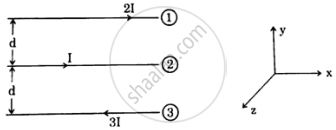
Find the magnitude and direction of:
- net magnetic field at a point on conductor 1 and
- net magnetic force acting on unit length of conductor 1, due to conductors 2 and 3.
Chapter:
A rectangular loop of sides l and b and resistance ‘R’ is kept in a region in which the magnetic field varies as B = B0 sin ωt.
- Derive expression for the emf induced in the loop.
- Find the effective value of current that flows in the loop.
Chapter:
Draw the circuit diagram of a full wave rectifier. Explain its working showing its input and output waveforms.
Chapter:
In Bohr model of hydrogen atom, calculate:
- the radius of the innermost electron orbit, and
- the speed of electron in this orbit.
Chapter:
Explain how the dual aspect of matter is evident in the de Broglie relation.
Chapter:
Radiation of wavelength λ is incident on a photosensitive surface. Find the de Broglie wavelength of electrons emitted from the surface. Assume that the work function of the surface is negligible.
Chapter:
A conducting rectangular loop of area 5 cm2 and resistance 4 Ω is removed from a region of uniform magnetic field, acting normal to the plane of the loop. The value of induced current I in the loop varies with time t, as shown in the figure.
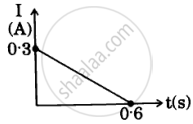
Find:
- total charge that passed through the loop.
- change in magnetic flux through the loop.
- magnitude of magnetic field in the region.
Chapter:
The two Kirchhoff’s rules are based on the law of conservation of two physical quantities. Name the quantities.
Chapter:
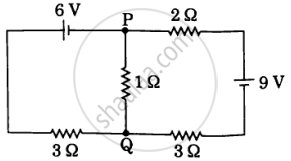
Find magnitude and direction of current in 1 Ω resistor in the given circuit.
Chapter:
Read the following paragraph and answer the questions that follow.
| An astronomical telescope consists of two converging lenses. One of them of large aperture and large focal length is called objective lens and the other one, of smaller focal length and smaller aperture is called the eyepiece. It is used to see distant objects which are not seen clearly with naked eyes. The image formed by the objective lens acts as an object for the eyepiece and the final image produced by the eyepiece is magnified. |
i. The images formed by the objective lens and the eyepiece are respectively ______.
- virtual, real
- real, virtual
- virtual, virtual
- real, real
ii. The magnification produced by the telescope does not depend upon the ______.
- colour of light.
- focal length of objective lens.
- focal length of eyepiece.
- apertures of objective lens and eyepiece.
iii. Which of the following statements is not correct for this telescope?
- The focal length of objective lens (fo) is larger than the focal length of eyepiece (fe).
- Its magnifying power can be increased by increasing the focal length of objective lens (fo).
- The distance between two lenses is more than (fo + fe).
- The magnifying power can be decreased by increasing the focal length of eyepiece.
iv. a. An astronomical telescope has objective lens and eyepiece of focal lengths 80 cm and 4 cm respectively. To view the image in normal adjustment, the lenses must be separated by a distance of ______.
- 84 cm
- 76 cm
- 20 cm
- 320 cm
OR
b. Consider the telescope described in question (iv)(a). Its magnifying power in normal adjustment will be:
- 320
- 84
- 76
- 20
Chapter:
Read the following paragraph and answer the questions that follow.
|
A student sets up the circuit as shown in the figure to find the value of unknown resistance X and records a set of readings of the voltmeter and the ammeter by using the rheostat.
|
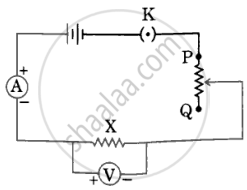
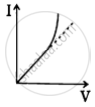
i. If resistor X were made of manganin and readings for V and I are taken without switching off the circuit, the graph between V and I will be as:


ii. Error in the value of X obtained from different sets of voltmeter and ammeter readings, is ______.
- due to error in voltmeter reading only.
- due to error in ammeter reading only.
- equal to the sum of error in voltmeter reading and error in ammeter reading.
- equal to error in voltmeter reading divided by the error in ammeter reading.
iii. If the movable end of rheostat is moved towards P, then ______.
- reading in ammeter decreases and reading in voltmeter increases.
- readings in both voltmeter and ammeter increase.
- reading in ammeter increases and reading in voltmeter decreases.
- readings in both voltmeter and ammeter decrease.
iv. a. Suppose the unknown resistance X is replaced by a wire made of the same metal. This wire consists of three parts of the same length L but has radii r, `r/3` and `r/2` as shown in the figure.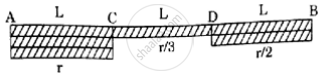
For a particular setting of the rheostat, let v1, v2 and v3 be the value of drift velocities in parts AC, CD and DB. Then:
- v1 > v2 > v3
- v2 > v3 > v1
- v3 > v2 > v1
- v1 = v2 = v3
OR
b. Consider the same wire, as shown in figure in question (iv)(a) connected in place of X. For a particular setting of rheostat, let E1, E2 and E3 be the value of electric fields in part AC, CD and DB. Then:
- E1 = E2 = E3
- E3 > E2 > E1
- E2 > E3 > E1
- E1 > E2 > E3
Chapter:
Explain the following statement giving reason:
An equipotential surface through a point is normal to the electric field at that point.
Chapter:
Advertisements
Explain the following statement giving reason:
When a dielectric is placed in an external electric field, the electric field inside the dielectric is less than that outside it.
Chapter:
Explain the following statement giving reason:
The potential difference between the plates of a charged parallel plate capacitor decreases when its plates are brought closer.
Chapter:
Obtain an expression for the work done to dissociate the system of three charges q, −4q and 2q placed at the vertices A, B and C respectively of an equilateral triangle of side ‘a’.
Chapter:
Answer the following giving reason:
The electron drift speed is estimated to be only a few mm/s for currents in the range of a few amperes. How, then, is the current established almost the instant a circuit is closed?
Chapter:
A low voltage supply from which one needs high currents must have very low internal resistance. Why?
Chapter: [3] Current Electricity
Answer the following giving reason:
The assertion that V = IR is a statement of Ohm’s law is not true. Why?
Chapter:
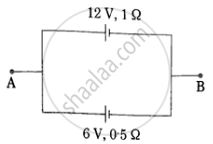
Two cells of emfs 12 V and 6 V are connected in parallel as shown in the figure. Their internal resistances are 1 Ω and 0.5 Ω respectively. Calculate the emf and internal resistance of the equivalent cell between points A and B.
Chapter:
Define refractive index of a medium in terms of speed of light.
Chapter:
Derive the relation for the refractive index (µ) of a prism in terms of angle of minimum derivation (δm) and angle of prism (A).
Chapter:
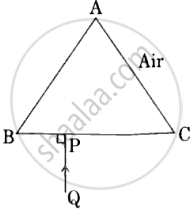
A ray of light QP is incident normally on the face BC of a triangular prism ABC of refractive index 1.5 kept in air, as shown in the figure. Trace the path of the ray as it passes through the prism and give relevant explanation.
Chapter:
With the help of a diagram, show how a plane wave is reflected from a surface. Hence, verify the law of reflection.
Chapter: [10] Wave Optics
Depict refraction of a plane wave by a convex lens.
Chapter:
Define the term power factor of a series LCR circuit.
Chapter:
For what value of the power factor will the power dissipated in the circuit be maximum?
Chapter:
An inductor of `5/pi` H, a capacitor of `50/pi` µF and a resistor of 400 Ω are connected in series across an ac voltage v = 140 sin(100 πt) V. Calculate:
- impedance of the circuit, and
- rms value of current that flows in the circuit. (Take `sqrt 2` = 1.4)
Chapter:
Draw a labelled diagram to show the various components of a step-up transformer.
Chapter:
Obtain the ratio of secondary voltage to primary voltage in terms of number of turns in the two coils.
Chapter:
The number of turns in the primary and the secondary coil of an ideal transformer are 100 and 5000 respectively. If 3.3 kW power is supplied to the transformer at 220 V, find
- current in the primary coil, and
- output voltage.
Chapter:
Other Solutions
Submit Question Paper
Help us maintain new question papers on Shaalaa.com, so we can continue to help studentsonly jpg, png and pdf files
CBSE previous year question papers Class 12 Physics with solutions 2025 - 2026
Previous year Question paper for CBSE Class 12 Physics-2026 is solved by experts. Solved question papers gives you the chance to check yourself after your mock test.
By referring the question paper Solutions for Physics, you can scale your preparation level and work on your weak areas. It will also help the candidates in developing the time-management skills. Practice makes perfect, and there is no better way to practice than to attempt previous year question paper solutions of CBSE Class 12.
How CBSE Class 12 Question Paper solutions Help Students ?
• Question paper solutions for Physics will helps students to prepare for exam.
• Question paper with answer will boost students confidence in exam time and also give you an idea About the important questions and topics to be prepared for the board exam.
• For finding solution of question papers no need to refer so multiple sources like textbook or guides.
