Advertisements
Advertisements
प्रश्न
With the help of a diagram, show how a plane wave is reflected from a surface. Hence, verify the law of reflection.
Draw the reflected wave front for a plane wave front incident on a plane reflecting surface. Hence, verify the laws of reflection using Huygen’s principle.
A plane wave is incident on a reflecting surface. Using Huygens principle, show how it is reflected from the surface. Hence, verify the law of reflection.
Advertisements
उत्तर १
According to the laws of reflection:
- At the point of incidence, the incident rays, reflected rays, and normal to the reflecting surface all lie in the same plane.
- On opposing sides of the normal are the incident and reflected rays.
- The angle of incidence and the angle of reflection are the same. i.e., ∠i = ∠r.
Explanation:
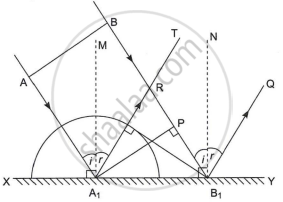
Reflection of light
XY: Plane reflecting surface
AB: Plane wavefront
RB1: Reflecting wavefront
A1M, B1N: Normal to the plane
∠AA1M = ∠BB1N = ∠i = Angle of incidence
∠TA1M = ∠QB1N = ∠r = Angle of reflection
A plane wavefront AB is advancing obliquely towards the plane reflecting surface XY. The AA1 and BB1 are incident rays.
When ‘A’ reaches XY at A1, then the ray at ‘B’ reaches point ‘P’, and it has to cover the distance PB1 to reach the reflecting surface XY.
Let ‘t’ be the time required to cover the distance PB1. During this time interval, secondary wavelets are emitted from A1 and will spread over a hemisphere of radius A1R, in the same medium. The distance covered by secondary wavelets to reach from A1 to R in time t is the same as the distance covered by primary waves to reach from P to B1. Thus, A1R = PB1 = ct.
All other rays between AA1 and BB1 will reach XY after A1 and before B1. Hence, they will also emit secondary wavelets of decreasing radii.
The surface touching all such hemispheres is RB1 which is the reflected wavefront, bounded by reflected rays A1R and B1Q.
Draw A1M ⊥ XY and B1N ⊥ XY.
Thus, the angle of incidence is ∠AA1M = ∠BB1N = i, and the angle of reflection is ∠MA1R = ∠NB1Q = r.
∠RA1B1 = 90 − r
∠PB1A1 = 90 − i
In ΔA1RB1 and ΔA1PB1
∠A1RB1 = ∠A1PB1
A1R = PB1 ...(Reflected waves travel an equal distance in the same medium in equal time.)
A1B1 = A1B1 ....(Common side)
∴ ΔA1RB1 ≅ ΔA1PB1
∴ ∠RA1B1 = ∠PB1A1
∴ 90 − r = 90 − i
∴ i = r
Also from the figure, it is clear that incident rays, reflected rays, and normal lie in the same plane.
This explains the laws of reflection of light from a plane reflecting surface on the basis of Huygen’s wave theory.
Frequency, wavelength, and speed of light do not change after reflection. If reflection takes place from a denser medium, then the phase changes by π radians.
उत्तर २
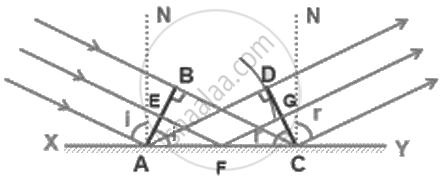
AB = Incident wavefront
CD = Reflected wavefront
XY = Reflecting surface
If c be the speed of light and t be the time taken by light to go from B to C or A to D or E to G through F, then
t = `(EF)/C + (FG)/C`
= `(AF sin i)/C + (FC sin r)/C`
= `(AC sin r + AF(sin i - sin r))/C`
For rays of light from different parts of the incident wavefront, the values of AF are different. But light from different points of the incident wavefront should take the same time to reach the corresponding points on the reflected wavefront.
So, ‘t’ should not depend upon AF.
This is possible only if sin i – sin r = 0.
i.e., sin i = sin r
⇒ i = r
Hence proved.
Notes
Students can refer to the provided solutions based on their preferred marks.
APPEARS IN
संबंधित प्रश्न
An air bubble in glass slab (µ = 1.5) when viewed from one side, appears to be at 6 cm and from opposite side 4 cm. The thickness of glass slab is ______.
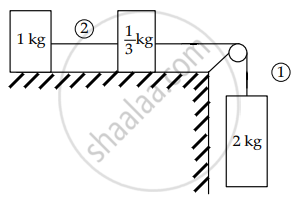
All the surfaces are frictionless. Strings are light and frictionless. The tension in string 1 is ______ N. (Take g = 10 m/s2)
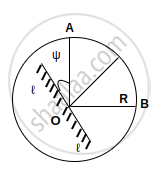
The mirror of length 2l makes 10 revolutions per minute about the axis crossing its mid-point O and perpendicular to the plane of the figure There is a light source in point A and an observer at point B of the circle of radius R drawn around centre O (∠AOB = 90°) What is the proportion `"R"/ℓ` if the observer B first sees the light source when the angle of mirror ψ = 15°?
Two spherical mirrors, one convex and the other concave, each of same radius of curvature R are arranged coaxially at a distance of 2R from each other. A small circle of radius a is drawn on the convex mirror as shown in figure. What is the radii of first two images of the circle?

What is drawn from point A to construct the reflected wavefront?
Which equality relates AE to the distance advanced by the wavefront from B to C?
What happens to a plane wave as it passes through a thin prism?
How does the speed of light waves in glass affect a plane wave passing through a thin prism?
What is the frequency of light emitted by a charged oscillator?
For a given frequency, what determines the intensity of light in the photon picture?
