Advertisements
Advertisements
प्रश्न
Light of wavelength 5000 Å falls on a plane reflecting surface. What are the wavelength and frequency of the reflected light? For what angle of incidence is the reflected ray normal to the incident ray?
Advertisements
उत्तर
Wavelength of incident light, λ = 5000 Å = 5000 × 10−10 m
Speed of light, c = 3 × 10⁸ m
Frequency of incident light is given by the relation,
`"v" = "c"/lambda`
= `(3 xx 10^8)/(5000 xx 10^(-10))`
= 6 × 10¹⁴ Hz
The wavelength and frequency of incident light is the same as that of the reflected ray. Hence, the wavelength of reflected light is 5000 Å and its frequency is 6 × 10¹⁴ Hz.
When a reflected ray is normal to incident ray, the sum of the angle of incidence, `angle"i"` and angle of reflection, `angle"r"` is 90°.
According to the law of reflection, the angle of incidence is always equal to the angle of reflection. Hence, we can write the sum as:
`angle"i" + angle"r" = 90`
`angle"i" + angle"i" = 90`
`angle"i" = 90/2` = 45°
Therefore, the angle of incidence for the given condition is 45°.
APPEARS IN
संबंधित प्रश्न
The propagation of light is best described by ______.
The quantity which does NOT change during reflection is ______.
An air bubble in glass slab (µ = 1.5) when viewed from one side, appears to be at 6 cm and from opposite side 4 cm. The thickness of glass slab is ______.
Two spherical mirrors, one convex and the other concave, each of same radius of curvature R are arranged coaxially at a distance of 2R from each other. A small circle of radius a is drawn on the convex mirror as shown in figure. What is the radii of first two images of the circle?

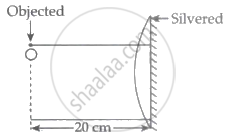
An object O is placed at a distance of 20 cm from a thin plano-convex lens of a focal length of 15 cm. The place surface of the lens is silvered as shown in the figure. The image is formed at a distance of ______.
With the help of a diagram, show how a plane wave is reflected from a surface. Hence, verify the law of reflection.
If \[v\] is the speed of the wave and \[\tau\] is the time taken by the wavefront to advance from B to C, what is the distance BC?
What happens to a plane wave as it passes through a thin prism?
Which portion of an incoming wavefront is delayed more by a thin prism, and why?
What feature appears in the emerging wavefront of a plane wave passing through a thin convex lens?
What kind of wave is formed when a plane wave is reflected by a concave mirror?
Where does the spherical wave reflected by a concave mirror converge?
What is the frequency of light emitted by a charged oscillator?
When light travels from a rarer to a denser medium, what happens to its speed?
For a given frequency, what determines the intensity of light in the photon picture?
