Advertisements
Advertisements
प्रश्न
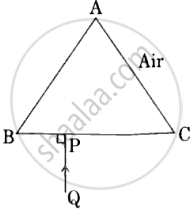
A ray of light QP is incident normally on the face BC of a triangular prism ABC of refractive index 1.5 kept in air, as shown in the figure. Trace the path of the ray as it passes through the prism and give relevant explanation.
Advertisements
उत्तर
A beam enters the medium undisturbed when it is incident ordinarily (i = 0°). After that, it strikes a different surface, and how it behaves depends on whether the angle of incidence is greater than the critical angle (ic).
Critical angle (ic) = `sin^-1 (1/µ)`
If i > ic, total internal reflection (TIR) occurs.
The ray QP is incident normally on BC, so it enters the prism without bending and travels straight.
Assuming the prism is equilateral (A = 60°), the ray hitting the side AC will have an angle of incidence (i) = 60°.
μ = 1.5
sin ic = `1/1.5`
= `2/3`
sin ic ≈ 0.66
ic ≈ 41.8°
The ray will experience total internal reflection (TIR) at the face because the angle of incidence (i) = 60°, is larger than the critical angle, ic ≈ 41.8°. The rules of reflection will cause it to reflect back into the prism.
∴ The ray enters undeviated, hits the slanted face at 60°, and undergoes total internal reflection because the angle of incidence exceeds the critical angle.
