Advertisements
Advertisements
प्रश्न
Two cells of same emf E but internal resistance r1 and r2 are connected in series to an external resistor R (Figure). What should be the value of R so that the potential difference across the terminals of the first cell becomes zero.
Advertisements
उत्तर
In this problem first we apply Ohm' law to find current in the circuit.
Effective emf of two cells = E + E = 2E
Effective resistance = R + r1 + r2
So the electric current is given by
`I = (E + E)/(R + r_1 + r_2)`
`V_1 = E - Ir_1 = E - (2E.r_1)/(R + r_1 + r_2)`
The net potential difference across 1st cell V1 = 0 (Given)
∴ `E - (2Er_1)/(R + r_1 + r_2)` = 0
Or `1 - (2r_1)/(R + r_1 + r_2)` = 0
`(2r_1)/(r_1 + r_2 + R) = 1/1`
Or 2r1 = r1 + r2 + R
| r1 – r2 = R |
It is the required condition for the potential difference across 1st cell to be zero.
APPEARS IN
संबंधित प्रश्न
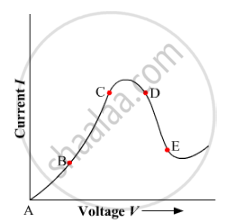
Graph showing the variation of current versus voltage for a material Ga As is shown in the figure. Identify the region of
(i) negative resistance
(ii) where Ohm's law is obeyed.
Let the resistance of an electrical component remains constant while the potential difference across the two ends of the component decreases to half of its former value. What change will occur in the current through it?
Write the formula of resistivity
An electrical bulb is marked 200V, 100W. Calculate the electrical resistance of its filament. If five such
bulbs are connected in series to a 200V supply, how much current will flow through them?
Find the expression for the resistivity of a material and state the SI unit of resistivity.
- Draw a V-I graph for a conductor obeying Ohm’s law.
- What does the slope of V–I graph for a conductor represent?
In the circuit shown below in Fig, calculate the value of x if the equivalent resistance between A and B is 4 Ω.

A metal sphere is kept on an insulting stands. A negatively charged rod is brought near it, then the sphere is earthed as shown. On removing the earthing, and taking the negatively charged rod away, what will be the nature of charge on the sphere? Give reason for your answer.

- Name and state the law which relates the potential difference and current in a conductor.
- What is the necessary condition for a conductor to obey the law named above in part (a) ?
What are ohmic conductors? Give one exmaple. Draw a graph showing the current-voltage relationship for an ohmic conductor.
SI unit of resistance is:
State macroscopic form of Ohm’s law.
The slope of voltage (V) versus current (I) is called:

Assertion: The statement of Ohm’s law is K = IR.
Reason: V = IR is the equation which defines resistance.
A current of 0.8 A flows in a conductor of 40 Ω for 1 minute. The heat produced in the conductor will be ______.
Resistance (R) in a conductor is best described as:
If a current of 1 A flows through a conductor, then according to Ohm's Law, the resistance of the conductor is:
Which formula is used with Ohm's Law to help determine power consumption in an electrical circuit?
If the voltage across a conductor is increased while its temperature remains unchanged, what happens to the current flowing through it?
