Advertisements
Advertisements
प्रश्न
Two conductors are made of the same material and have the same length. Conductor A is a solid wire of diameter 1 mm. Conductor B is a hollow tube of outer diameter 2 mm and inner diameter 1 mm. Find the ratio of resistance RA to RB.
Advertisements
उत्तर
We know that the resistance of wire is `R = ρ l/A` where A is cross-sectional area of conductor and ρ is the specific resistance or resistivity and L is the length of conductor.
The resistance of first conductor
`R_A = (ρl)/(pi(10^-3 xx 0.5)^2`
The resistance of second conductor,
`R_B = (ρl)/(pi[(10^-3)^2 - (0.5 xx 10^-3)^2]`
Now, the ratio of two resistors is given by
`R_A/R_B = ((10^-3)^2 - (0.5 xx 10^-3)^2)/(0.5 xx 10^-3)^2` = 3:1
APPEARS IN
संबंधित प्रश्न
If the potential difference across the ends of a conductor is 220 V and the resistance of the conductor is 44 Ω (ohm), then the current flowing through is _________.
- 0.2 A
- 0.5 A
- 2 A
- 5 A
Write the formula of resistivity
Write the SI unit of resistivity
- Draw a V-I graph for a conductor obeying Ohm’s law.
- What does the slope of V–I graph for a conductor represent?
A wire of resistance 3 ohm and length 10 cm is stretched to length 30 cm. Assuming that it has a uniform cross section, what will be its new resistance?
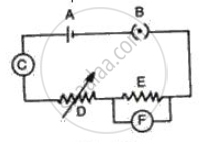
Fig. represents the circuit used for the verification of ohm's law. Label the different parts from A and F. State the function of each.
Define ampere and volt with respect to Ohm’s law.
State the limitations of Ohm’s law.
What are non-ohmic conductors? Give one exmaple. Draw a current-voltage graph for a non-ohmic conductor.
What is ohmic device?
Which of the following I-V graph represents ohmic conductors?

Calculate the total resistance of the circuit and find the total current in the circuit.
A metal rod of length 10 cm and a rectangular cross-section of 1 cm × `1/2` cm is connected to a battery across opposite faces. The resistance will be ______.
Suppose there is a circuit consisting of only resistances and batteries and we have to double (or increase it to n-times) all voltages and all resistances. Show that currents are unaltered. Do this for circuit of Example 3.7 in the NCERT Text Book for Class XII.
How is electric current related to the potential difference across the terminals of a conductor?
Draw a labelled circuit diagram to verify this relationship.
A current of 3.2 mA flows through a conductor. If charge on an electron is −1.6 × 10⁻¹⁹ coulomb, find the number of electrons that will pass each second through the cross section of that conductor.
Ohm's Law states that for a metallic conductor, the current flowing through it is directly proportional to the potential difference across its ends, provided that:
Resistance (R) in a conductor is best described as:
What is the nature of the graph obtained when potential difference is plotted against current for an Ohmic conductor?
If the voltage across a conductor is increased while its temperature remains unchanged, what happens to the current flowing through it?
