Advertisements
Advertisements
प्रश्न
State and define Ohm’s law.
Advertisements
उत्तर
Ohm’s law states that at a constant temperature, the current flowing in a conductor is directly proportional to the potential difference across its ends, i.e., if the potential difference is halved, the current is also halved and if p.d. is doubled, the current is also doubled, i.e.,
V (potential difference) ∝ i (current)
Or V = iR, where R is constant, called the resistance of the conductor.
So V = iR represents Ohm’s law.
संबंधित प्रश्न
Name the law which is illustrated by the above V−I graph.
What is the necessary condition for a conductor to obey Ohm’s law?
- Draw a V-I graph for a conductor obeying Ohm’s law.
- What does the slope of V–I graph for a conductor represent?
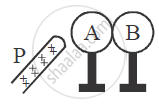
Two metallic spheres A and B kept on insulating stands are in contact with each other. A positively charged rod P is brought near the sphere A as shown in the figure. The two spheres are separated from each other, and the rod P is removed. What will be the nature of charges on spheres A and B?
What is meant by the drift speed of free electrons?
State Ohm’s law.
Define Current density.
A metal rod of length 10 cm and a rectangular cross-section of 1 cm × `1/2` cm is connected to a battery across opposite faces. The resistance will be ______.
In which unit is the resistance of a conductor measured?
