Advertisements
Advertisements
प्रश्न
How would you connect two resistors in series? Draw a diagram. Calculate the total equivalent resistance.
Advertisements
उत्तर
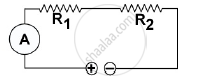
If current I is drawn from the battery, the current through each resistor will also be I.
On applying Ohm's law to the two resistors separately, we further
have
`"V"_1 = "I R"_1`
`"V"_2 = "I R"_2`
`"V" = "V"_1 + "V"_2`
`"IR" = "I R"_1+ "I R"_2`
`"IR" = "I " ["R"_1+ "R"_2]`
`"R" = "R"_1+ "R"_2`
Total Resistance in series R
`"R" = "R"_1+"R"_2+"R"_3`
APPEARS IN
संबंधित प्रश्न
When a 12 V battery is connected across an unknown resistor, there is a current of 2.5 mA in the circuit. Find the value of the resistance of the resistor.
What is an Ohmic resistor?
Four resistances of 16 ohms each are connected in parallel. Four such combinations are connected in series. What is the total resistance?
The filament of a bulb takes a current 100 mA when potential difference across it is 0.2 V. When the potential difference across it becomes 1.0 V, the current becomes 400 mA. Calculate the resistance of filament in each case and account for the difference.
Which of the following is correct for V-I graph of a good conductor?
A student carries out an experiment and plots the V-I graph of three samples of nichrome wire with resistances R1, R2 and R3 respectively. Which of the following is hue?

Suppose there is a circuit consisting of only resistances and batteries and we have to double (or increase it to n-times) all voltages and all resistances. Show that currents are unaltered. Do this for circuit of Example 3.7 in the NCERT Text Book for Class XII.
State Ohm's Law. Represent it mathematically.

Vinita and Ahmed demonstrated a circuit that operates the two headlights and the two sidelights of a car, in their school exhibition. Based on their demonstrated circuit, answer the following questions.
- State what happens when switch A is connected to:
a) Position 2
b) Position 3 - Find the potential difference across each lamp when lit.
- Calculate the current.
a) in each 12 Ω lamp when lit.
b) In each 4 Ω lamp when lit.
OR - Show, with calculations, which type of lamp, 4.0 Ω or 12 Ω, has the higher power.
A resistor is connected in a circuit with a voltage of 12 V and a resistance of 24 Ω. What is the current flowing through the resistor?
