Advertisements
Advertisements
प्रश्न
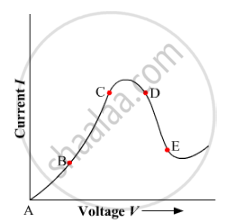
Graph showing the variation of current versus voltage for a material Ga As is shown in the figure. Identify the region of
(i) negative resistance
(ii) where Ohm's law is obeyed.
Advertisements
उत्तर
(i) DE is the region of negative resistance because the slope of curve in this part is negative.
(ii) Where Ohmâs law is obeyed - AB. BC might also be applicable to this particular category.
APPEARS IN
संबंधित प्रश्न
Write the SI unit of resistivity
Name the physical quantity whose unit is "ohm".
Calculate the current flowing through a wire of resistance 5 Ω connected to a battery of potential difference 3 V.
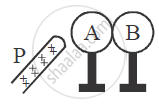
Two metallic spheres A and B kept on insulating stands are in contact with each other. A positively charged rod P is brought near the sphere A as shown in the figure. The two spheres are separated from each other, and the rod P is removed. What will be the nature of charges on spheres A and B?
Define the following:
Coulomb
Assertion: The statement of Ohm’s law is K = IR.
Reason: V = IR is the equation which defines resistance.
What is the resistance of a conductor through which a current of 0.5 A flows when a potential difference of 2V is applied across its ends?
Let the resistance of an electrical device remain constant, while the potential difference across its two ends decreases to one fourth of its initial value. What change will occur in the current through it? State the law which helps us in solving the above stated question.
If a current of 1 A flows through a conductor, then according to Ohm's Law, the resistance of the conductor is:
What is the nature of the graph obtained when potential difference is plotted against current for an Ohmic conductor?
