Advertisements
Advertisements
प्रश्न
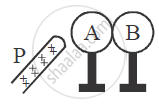
Two metallic spheres A and B kept on insulating stands are in contact with each other. A positively charged rod P is brought near the sphere A as shown in the figure. The two spheres are separated from each other, and the rod P is removed. What will be the nature of charges on spheres A and B?
Advertisements
उत्तर १
On sphere A there will be negative charge & one sphere B there will be positive charge

उत्तर २
When we bring a positively charged rod near the sphere A, The free electrons in the spheres are attracted to the rod. This leaves an excess of positive charge on the farther surface of sphere B. Now after separating the spheres and removing the rod, the charges on spheres rearrange themselves and get uniformly distributed over them, as shown in Figure given below.

संबंधित प्रश्न
Why are coils of electric toasters and electric irons made of an alloy rather than a pure metal?
Fill in the following blank with suitable words:
Resistance is measured in .............. The resistance of a wire increases as the length ..............; as the temperature ..............; and as the cross-sectional area .............. .
Consider the sacle of voltmeter shown in the diagram and answer the following questions :

(a) What is the least count of the voltmeter?
(b) What is the reading shown by the voltmeter ?
(c) If the voltmeter is connected across a resistor of 20 `Omega` how much current is flowing through the resistor?
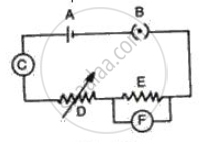
Fig. represents the circuit used for the verification of ohm's law. Label the different parts from A and F. State the function of each.
What is non-ohmic resistor?
An electronics hobbyist is building a radio which requires 150 Ω in her circuit, but she has only 220 Ω, 79 Ω, and 92 Ω resistors available. How can she connect the available resistors to get the desired value of resistance?
A student carries out an experiment and plots the V-I graph of three samples of nichrome wire with resistances R1, R2 and R3 respectively. Which of the following is true?

Why should an ammeter have low resistance?
The mathematical form of Ohm's Law is:
