Advertisements
Advertisements
प्रश्न
Why should an ammeter have low resistance?
Advertisements
उत्तर
An ammeter has a low resistance, which makes it easy for all the current to flow through the circuit without energy loss from heat losses. This means that it does not impede or alter the flow of electric current.
APPEARS IN
संबंधित प्रश्न
If the potential difference across the ends of a conductor is 220 V and the resistance of the conductor is 44 Ω (ohm), then the current flowing through is _________.
- 0.2 A
- 0.5 A
- 2 A
- 5 A
Will current flow more easily through a thick wire or a thin wire of the same material, when connected to the same source? Why?
Find the expression for the resistivity of a material and state the SI unit of resistivity.
Name the law which is illustrated by the above V−I graph.
- Draw a V-I graph for a conductor obeying Ohm’s law.
- What does the slope of V–I graph for a conductor represent?
Which of the following is an ohmic resistance?
A metal sphere is kept on an insulting stands. A negatively charged rod is brought near it, then the sphere is earthed as shown. On removing the earthing, and taking the negatively charged rod away, what will be the nature of charge on the sphere? Give reason for your answer.

Fig. represents the circuit used for the verification of ohm's law. Label the different parts from A and F. State the function of each.
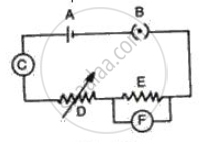
State microscopic form of Ohm’s law.
How is electric current related to the potential difference across the terminals of a conductor?
Draw a labelled circuit diagram to verify this relationship.
