Advertisements
Advertisements
प्रश्न
Why should an ammeter have low resistance?
Advertisements
उत्तर
An ammeter has a low resistance, which makes it easy for all the current to flow through the circuit without energy loss from heat losses. This means that it does not impede or alter the flow of electric current.
APPEARS IN
संबंधित प्रश्न
Write the SI unit of resistivity
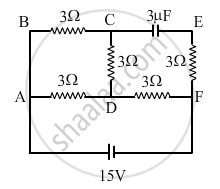
In the circuit shown in the figure, find the total resistance of the circuit and the current in the arm AD.
The filament of a bulb takes a current 100 mA when potential difference across it is 0.2 V. When the potential difference across it becomes 1.0 V, the current becomes 400 mA. Calculate the resistance of filament in each case and account for the difference.
An ammeter placed in series with an electric radiator reads 0.5 amps and a voltmeter placed across it reads 230 volts. What is the resistance of the radiator?
Define Current density.
State microscopic form of Ohm’s law.
The resistance of a nichrome wire at 0°C is 10Ω. If its temperature coefficient of resistivity of nichrome is 0.004/ °C, find its resistance of the wire at boiling point of water. Comment on the result.
The variable resistance is called ____________.
What is meant by resistance of a conductor ? Define its SI unit.
How is electric current related to the potential difference across the terminals of a conductor?
Draw a labelled circuit diagram to verify this relationship.
