Advertisements
Advertisements
प्रश्न
A metal sphere is kept on an insulting stands. A negatively charged rod is brought near it, then the sphere is earthed as shown. On removing the earthing, and taking the negatively charged rod away, what will be the nature of charge on the sphere? Give reason for your answer.

Advertisements
उत्तर १
There will be positive charge on the sphere.
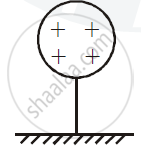
Reason :
Negatively charged rod will induce positive charge on the sphere and negative charge well move in ground from other end.
उत्तर २
When we bring a negatively charged rod near the metal sphere, the free electrons in the sphere move away due to repulsion force and start piling up at the other end. The rear end becomes positively charged due to the deficit of electrons. After connecting the sphere to the ground, the electrons flow to the ground while the positive charges at the rear end remain as it is due to the attractive force of the negative charges on the rod. When the sphere is disconnected from the ground and the charged rod is removed, the positive charge spreads uniformly over the sphere as shown in the Figure below:

संबंधित प्रश्न
Why are coils of electric toasters and electric irons made of an alloy rather than a pure metal?
The graph between V and I for a conductor is a straight line passing through the origin.
What should remain constant in a statement of this law?
Four resistances of 16 ohms each are connected in parallel. Four such combinations are connected in series. What is the total resistance?
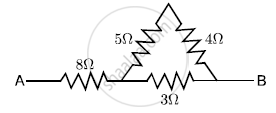
Calculate the effective resistance across AB?
What is non-ohmic resistor?
Obtain the macroscopic form of Ohm’s law from its microscopic form and discuss its limitation.
Explain the equivalent resistance of a parallel resistor network.
The temperature of a conductor is increased. The graph best showing the variation of its resistance is:
The circuit depicted in the figure is employed for studying Ohm’s Law. Instead of using a standard resistor, a student opts for a glass tube filled with mercury (tube 1), connected to the circuit through two electrodes, E1 and E2. He records the readings of the ammeter and voltmeter, thereby calculating the resistance. The student repeats the experiment by substituting tube 1 with tube 2, where the same amount of mercury fills tube 2.
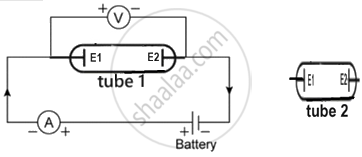
Neglecting internal resistance of the cell use (> or < or =) to compare:
- the resistance in both the cases.
- the voltmeter readings in both the cases.
- the specific resistance in both the cases.
Ohm's Law states that for a metallic conductor, the current flowing through it is directly proportional to the potential difference across its ends, provided that:
