Advertisements
Advertisements
Question
A metal sphere is kept on an insulting stands. A negatively charged rod is brought near it, then the sphere is earthed as shown. On removing the earthing, and taking the negatively charged rod away, what will be the nature of charge on the sphere? Give reason for your answer.

Advertisements
Solution 1
There will be positive charge on the sphere.
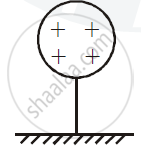
Reason :
Negatively charged rod will induce positive charge on the sphere and negative charge well move in ground from other end.
Solution 2
When we bring a negatively charged rod near the metal sphere, the free electrons in the sphere move away due to repulsion force and start piling up at the other end. The rear end becomes positively charged due to the deficit of electrons. After connecting the sphere to the ground, the electrons flow to the ground while the positive charges at the rear end remain as it is due to the attractive force of the negative charges on the rod. When the sphere is disconnected from the ground and the charged rod is removed, the positive charge spreads uniformly over the sphere as shown in the Figure below:

RELATED QUESTIONS
How much energy is consumed when a current of 5 amperes flows through the filament (or element) of a heater having resistance of 100 ohms for two hours? Express it in joules.
A wire has a length of 2.0 m and a resistance of 5.0 Ω. Find the electric field existing inside the wire if it carries a current of 10 A.
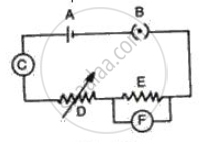
Fig. represents the circuit used for the verification of ohm's law. Label the different parts from A and F. State the function of each.
What is non-ohmic resistor?
The ratio of the potential difference to the current is known as ________.
Obtain the macroscopic form of Ohm’s law from its microscopic form and discuss its limitation.
The unit of specific resistance is ____________.
The variable resistance is called ____________.
Consider a current carrying wire (current I) in the shape of a circle. Note that as the current progresses along the wire, the direction of j (current density) changes in an exact manner, while the current I remain unaffected. The agent that is essentially responsible for is ______.
If a current of 1 A flows through a conductor, then according to Ohm's Law, the resistance of the conductor is:
