Advertisements
Advertisements
Question
What length of copper wire of resistivity 1.7 × 10⁻⁸ Ω m and radius 1 mm is required so that its resistance is 2Ω?
Advertisements
Solution
Resistance (R) = 2 ohm
Resistivity (ρ) = 1.7 × 10⁻⁸ ohm metre
Radius (r) = 1 mm = 10-3 m
Length (l) = ?
`R=ρ l/A`
`ρ=l/(pir^2)`
Substituting the values in the formula above we get,
`2 = 1.7xx10^-8l/(pi(10^-3)^2)`
`2 = 1.7xx10^-8l/(3.14xx(10^-3)^2)`
`2=(1.7xx10^-2xxl)/3.14`
`2 =(1.7xxl)/314`
⇒ l = `(314xx2)/1.7`
⇒ l = 369.4 m
Hence, the length of the copper wire = 369.4 m.
RELATED QUESTIONS
What will be the change in the current if the potential difference is kept constant and the resistance of the circuit is made four times?
- It will remain unchanged.
- It will become four times.
- It will become one-fourth.
- It will become half.
Write the SI unit of resistivity
Name the unit of electrical resistance and give its symbol.
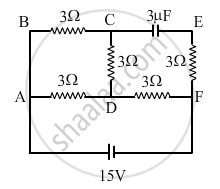
In the circuit shown in the figure, find the total resistance of the circuit and the current in the arm AD.
A metal sphere is kept on an insulting stands. A negatively charged rod is brought near it, then the sphere is earthed as shown. On removing the earthing, and taking the negatively charged rod away, what will be the nature of charge on the sphere? Give reason for your answer.

State the relation correlating the electric current flowing in a conductor and the voltage applied across it. Also, draw a graph to show this relationship.
Answer the following question.
Distinguish between Ohmic and non-ohmic substances; explain with the help of example.
What is non ohmic device?
Which of the following correctly defines Potential Difference (V) as one of the three core quantities of Ohm's Law?
In which unit is the resistance of a conductor measured?
