Advertisements
Advertisements
Question
An electronics hobbyist is building a radio which requires 150 Ω in her circuit, but she has only 220 Ω, 79 Ω, and 92 Ω resistors available. How can she connect the available resistors to get the desired value of resistance?
Advertisements
Solution
Available resistances = 220 Ω, 79 Ω 92 Ω
Case I:
If 3 resistors are connected in series, then
RS = R1 + R2 + R3 = 220 + 79 + 92 = 391
This value is greater than the required resistance so it is not possible.
Case II:
If 3 resistors are connected in parallel, then
`1/"R"_"p" = 1/"R"_1 + 1/"R"_2 + 1/"R"_3`
`1/"R"_"p" = 1/220 + 1/79 + 1/92` = 0.0279
Rp = 35.84 This does not meet the requirement.
Case III:
If R1 and R2 are connected in parallel and R3 in series
`1/"R"_"p" = 1/"R"_1 + 1/"R"_2 = 1/220 + 1/79 = 0.0172`
`=> "R"_"p" = 58.14 Omega`
This meets the requirement.
APPEARS IN
RELATED QUESTIONS
A low voltage supply from which one needs high currents must have very low internal resistance. Why?
Name the unit of electrical resistance and give its symbol.
How much energy is consumed when a current of 5 amperes flows through the filament (or element) of a heater having resistance of 100 ohms for two hours? Express it in joules.
Calculate the current flowing through a wire of resistance 5 Ω connected to a battery of potential difference 3 V.
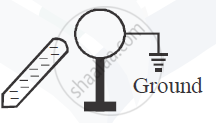
A metal sphere is kept on an insulting stands. A negatively charged rod is brought near it, then the sphere is earthed as shown. On removing the earthing, and taking the negatively charged rod away, what will be the nature of charge on the sphere? Give reason for your answer.
Choose the correct alternative.
Which of the following is an ohmic conductor?
The slope of voltage (V) versus current (I) is called:

State Ohm's Law. Represent it mathematically.

Vinita and Ahmed demonstrated a circuit that operates the two headlights and the two sidelights of a car, in their school exhibition. Based on their demonstrated circuit, answer the following questions.
- State what happens when switch A is connected to:
a) Position 2
b) Position 3 - Find the potential difference across each lamp when lit.
- Calculate the current.
a) in each 12 Ω lamp when lit.
b) In each 4 Ω lamp when lit.
OR - Show, with calculations, which type of lamp, 4.0 Ω or 12 Ω, has the higher power.
