Advertisements
Advertisements
Question
Explain the equivalent resistance of a parallel resistor network.
Advertisements
Solution
Resistors are in parallel when they are connected across the same potential difference as shown in the following figure.

Three resistors in parallel
In this case, the total current I that leaves the battery in split into three separate paths. Let I1, I2 and I3 be the current through the resistors R1, R2 and R3 respectively. Due to the conservation of charge, total current in the circuit I is equal to sum of the currents through each of the three resistors.
I = I1 + I2 + I3 ……. (1)
Since the voltage across each resistor is the same, applying Ohm’s law to each resistor, we have
`"I"_1 = "V"/"R"_1, "I"_2 = "V"/"R"_2, "I"_1 = "V"/"R"_3`
Substituting these values in equation (1), we get
I = `"V"/"R"_1 + "V"/"R"_2 + "V"/"R"_3`
= V`[1/"R"_1 + 1/"R"_2 + 1/"R"_3]`
I = `"V"/"R"_"p"`
`1/"R"_"p" = 1/"R"_1 + 1/"R"_2 + 1/"R"_3`
Here RP is the equivalent resistance of the parallel combination of the resistors. Thus, when a number of resistors are connected in parallel, the sum of the reciprocal of the values of resistance of the individual resistor is equal to the reciprocal of the effective resistance of the combination as shown in the following figure.

Equivalent resistance (RP) has the same current
APPEARS IN
RELATED QUESTIONS
If the potential difference across the ends of a conductor is 220 V and the resistance of the conductor is 44 Ω (ohm), then the current flowing through is _________.
- 0.2 A
- 0.5 A
- 2 A
- 5 A
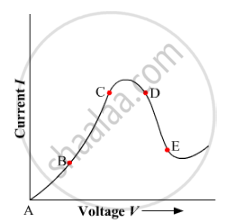
Graph showing the variation of current versus voltage for a material Ga As is shown in the figure. Identify the region of
(i) negative resistance
(ii) where Ohm's law is obeyed.
How much energy is consumed when a current of 5 amperes flows through the filament (or element) of a heater having resistance of 100 ohms for two hours? Express it in joules.
A resistance of 40 ohms and one of 60 ohms are arranged in series across 220 volt supply. Find the heat in joules produced by this combination of resistances in half a minute.
A metal sphere is kept on an insulting stands. A negatively charged rod is brought near it, then the sphere is earthed as shown. On removing the earthing, and taking the negatively charged rod away, what will be the nature of charge on the sphere? Give reason for your answer.

Rewrite the following statement by selecting the correct option.
The S.I. unit of resistance is __________.
Define Current density.
The variable resistance is called ____________.
A metal rod of length 10 cm and a rectangular cross-section of 1 cm × `1/2` cm is connected to a battery across opposite faces. The resistance will be ______.
The resistance of a resistor is reduced to half of its initial value. If other parameters of the electrical circuit remain unaltered, the amount of heat produced in the resistor will become ______.
