Advertisements
Advertisements
Question
What is meant by resistance of a conductor ? Define its SI unit.
Advertisements
Solution
Resistance is the quality of a conductor that causes it to resist the flow of an electric current through it. It is the proportion of the potential difference between ends to the current flowing. It has a Sl unit of ohm (Ω).
APPEARS IN
RELATED QUESTIONS
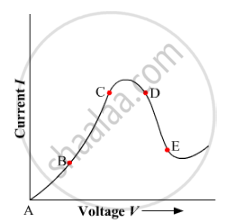
Graph showing the variation of current versus voltage for a material Ga As is shown in the figure. Identify the region of
(i) negative resistance
(ii) where Ohm's law is obeyed.
When a 12 V battery is connected across an unknown resistor, there is a current of 2.5 mA in the circuit. Find the value of the resistance of the resistor.
Calculate the electric field in a copper wire of cross-sectional area 2.0 mm2 carrying a current of 1 A.
The resistivity of copper = 1.7 × 10⁻⁸ Ω m
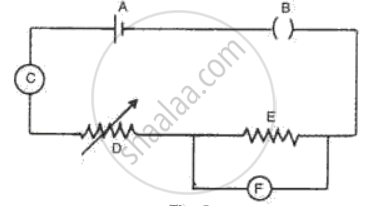
Fig. represents the circuit used for the verification of ohm's law. Label the different parts from A and F. State the function of each.
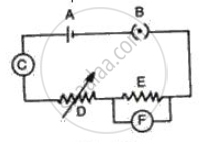
Fig. represents the circuit used for the verification of Ohm's law. Label the parts from A to F. state the function of each.
The ratio of the potential difference to the current is known as ________.
A wire connected to a power supply of 230 V has power dissipation P1. Suppose the wire is cut into two equal pieces and connected parallel to the same power supply. In this case, power dissipation is P2. The ratio of `"P"_2/"P"_1` is
An electronics hobbyist is building a radio which requires 150 Ω in her circuit, but she has only 220 Ω, 79 Ω, and 92 Ω resistors available. How can she connect the available resistors to get the desired value of resistance?
Two conductors are made of the same material and have the same length. Conductor A is a solid wire of diameter 1 mm. Conductor B is a hollow tube of outer diameter 2 mm and inner diameter 1 mm. Find the ratio of resistance RA to RB.
