Advertisements
Advertisements
प्रश्न
What is meant by resistance of a conductor ? Define its SI unit.
Advertisements
उत्तर
Resistance is the quality of a conductor that causes it to resist the flow of an electric current through it. It is the proportion of the potential difference between ends to the current flowing. It has a Sl unit of ohm (Ω).
APPEARS IN
संबंधित प्रश्न
What is an Ohmic resistor?
The resistors R1, R2, R3 and R4 in the figure given below are all equal in value.
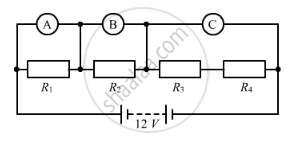
What would you expect the voltmeter A, B and C to read assuming that the connecting wires in the circuit have negligible resistance?
A resistance of 40 ohms and one of 60 ohms are arranged in series across 220 volt supply. Find the heat in joules produced by this combination of resistances in half a minute.
In a conductor 6.25 × `10^16` electrons flow from its end A to B in 2 s. Find the current flowing through the conductor (e = 1.6 × `10^-19` C)
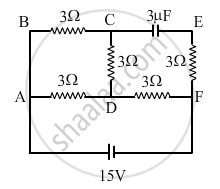
In the circuit shown in the figure, find the total resistance of the circuit and the current in the arm AD.
Consider the sacle of voltmeter shown in the diagram and answer the following questions :

(a) What is the least count of the voltmeter?
(b) What is the reading shown by the voltmeter ?
(c) If the voltmeter is connected across a resistor of 20 `Omega` how much current is flowing through the resistor?
State the relation correlating the electric current flowing in a conductor and the voltage applied across it. Also, draw a graph to show this relationship.
A heater of 220 V heats a volume of water m 5 mint time. A heater of 110 V heat in ten second. The resistance of the conductor is
Ohm's law deals with the relationship between ______
State Ohm's Law. Represent it mathematically.
