Advertisements
Advertisements
प्रश्न
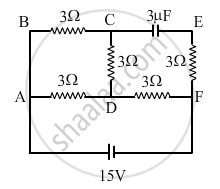
In the circuit shown in the figure, find the total resistance of the circuit and the current in the arm AD.
Advertisements
उत्तर
Since the capacitor will act as an open circuit here, the arm CE and EF will become ineffective. The circuit is now reduced to as below
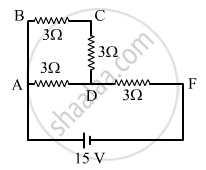
Effective resistance across AD = (BC + CD) ∥ AD
= \[\left( 3 + 3 \right) \lVert 3 = 2 \Omega\]
Total resistance of the circuit = AD + DF = 2 + 3 = 5 Ω
Total current in the circuit = \[\frac{15}{5} = 3 A\]
The current through AD and BCD will divide in the inverse ratio of the resistance.
∴ Current through AD = \[3 \times \frac{6}{\left( 6 + 3 \right)} = 3 \times \frac{6}{9} = 2 A\]
APPEARS IN
संबंधित प्रश्न
Why are coils of electric toasters and electric irons made of an alloy rather than a pure metal?
What is an Ohmic resistor?
Name the unit of electrical resistance and give its symbol.
The graph between V and I for a conductor is a straight line passing through the origin.
- Which law is illustrated by such a graph?
- What should remain constant in a statement of this law?
Show by a diagram how two resistors R1 and R2 are joined in parallel. Obtain an expression for the total resistance of the combination.
The filament of a bulb takes a current 100 mA when potential difference across it is 0.2 V. When the potential difference across it becomes 1.0 V, the current becomes 400 mA. Calculate the resistance of filament in each case and account for the difference.
What is non-ohmic resistor?
Choose the correct alternative.
Which of the following is an ohmic conductor?
Define temperature coefficient of resistance.
The unit of specific resistance is ____________.
