Advertisements
Advertisements
प्रश्न
Define Current density.
Advertisements
उत्तर
Current density is a vector quantity, often known as an area vector or cross-sectional area vector, whose value is equal to the electric current flowing per unit area.
J = `"I"/"A"`
S.I unit is A/m2.
APPEARS IN
संबंधित प्रश्न
When a 12 V battery is connected across an unknown resistor, there is a current of 2.5 mA in the circuit. Calculate the value of the resistance of the resistor.
Name the law which is illustrated by the above V−I graph.
The resistors R1, R2, R3 and R4 in the figure given below are all equal in value.
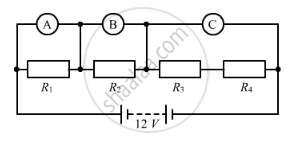
What would you expect the voltmeter A, B and C to read assuming that the connecting wires in the circuit have negligible resistance?
Four resistances of 16 ohms each are connected in parallel. Four such combinations are connected in series. What is the total resistance?
What is the necessary condition for a conductor to obey Ohm’s law?
A wire of resistance 3 ohm and length 10 cm is stretched to length 30 cm. Assuming that it has a uniform cross section, what will be its new resistance?
Show by a diagram how two resistors R1 and R2 are joined in parallel. Obtain an expression for the total resistance of the combination.
Calculate the electric field in a copper wire of cross-sectional area 2.0 mm2 carrying a current of 1 A.
The resistivity of copper = 1.7 × 10⁻⁸ Ω m
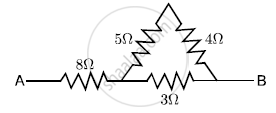
Calculate the effective resistance across AB?
Consider the sacle of voltmeter shown in the diagram and answer the following questions :

(a) What is the least count of the voltmeter?
(b) What is the reading shown by the voltmeter ?
(c) If the voltmeter is connected across a resistor of 20 `Omega` how much current is flowing through the resistor?
The ratio of the potential difference to the current is known as ________.
What is ohmic device?

Calculate the total resistance of the circuit and find the total current in the circuit.
The heat produced by a 100 w heater in 2 minute is equal to
What is meant by resistance of a conductor ? Define its SI unit.
In which unit is the resistance of a conductor measured?
The electric current between two joined conductors at different potentials continues to flow until:
If the voltage across a conductor is increased while its temperature remains unchanged, what happens to the current flowing through it?
