Advertisements
Advertisements
प्रश्न
Calculate the electric field in a copper wire of cross-sectional area 2.0 mm2 carrying a current of 1 A.
The resistivity of copper = 1.7 × 10⁻⁸ Ω m
Advertisements
उत्तर
Given:-
Area of cross-section, A = 2 × 10⁻⁶ m2
Current through the wire, i = 1 A
Resistivity of copper, ρ = 1.7 × 10⁻⁸ Ωm
Resistance of a wire,
\[R = \rho\frac{l}{A}\]
Also from Ohm's Law, voltage across a wire,
\[V = iR = \frac{i\rho l}{A}\]
The electric field of the wire,
\[E = \frac{V}{l}\]
Now:
`R = (fl)/A`
`= (1.7xx10^(-8)xxl)/(2xx10^-6)`
`V = iR = (1 xx1.7xx10^-8xxl)/(2xx10^-6)`
`E = (dV)/(dL) = V/l`
`= (1.7xx10^-8)/(2xx10^-6`
`= 1.7/2xx10^-2`
`= 17xx10^-3`
`= 8.5xx10^-3`mv/m.
APPEARS IN
संबंधित प्रश्न
Is Ohm’s law universally applicable for all conducting elements? If not, give examples of elements which do not obey Ohm’s law.
Write the formula of resistivity
Write the SI unit of resistivity
An electrical bulb is marked 200V, 100W. Calculate the electrical resistance of its filament. If five such
bulbs are connected in series to a 200V supply, how much current will flow through them?
The unit of electrical resistance is:
(a) ampere
(b) volt
(c) coulomb
(d) ohm
How would you connect two resistors in series? Draw a diagram. Calculate the total equivalent resistance.
In the circuit shown below in Fig, calculate the value of x if the equivalent resistance between A and B is 4 Ω.

Calculate the effective resistance across AB?
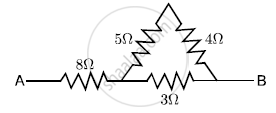
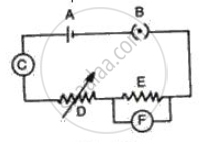
Fig. represents the circuit used for the verification of ohm's law. Label the different parts from A and F. State the function of each.
Draw a neat diagram for the verification of Ohm’s law by voltmeter-ammeter method. By another diagram show the relation between p.d. and current.
An ammeter placed in series with an electric radiator reads 0.5 amps and a voltmeter placed across it reads 230 volts. What is the resistance of the radiator?
Obtain the macroscopic form of Ohm’s law from its microscopic form and discuss its limitation.
The resistance of a nichrome wire at 0°C is 10Ω. If its temperature coefficient of resistivity of nichrome is 0.004/ °C, find its resistance of the wire at boiling point of water. Comment on the result.
A heater of 220 V heats a volume of water m 5 mint time. A heater of 110 V heat in ten second. The resistance of the conductor is
The resistance of a resistor is reduced to half of its initial value. If other parameters of the electrical circuit remain unaltered, the amount of heat produced in the resistor will become ______.
Why should an ammeter have low resistance?
The circuit depicted in the figure is employed for studying Ohm’s Law. Instead of using a standard resistor, a student opts for a glass tube filled with mercury (tube 1), connected to the circuit through two electrodes, E1 and E2. He records the readings of the ammeter and voltmeter, thereby calculating the resistance. The student repeats the experiment by substituting tube 1 with tube 2, where the same amount of mercury fills tube 2.
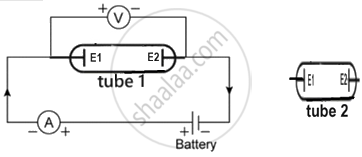
Neglecting internal resistance of the cell use (> or < or =) to compare:
- the resistance in both the cases.
- the voltmeter readings in both the cases.
- the specific resistance in both the cases.
In the context of Ohm's Law, Current (I) is defined as:
The mathematical form of Ohm's Law is:
