Advertisements
Advertisements
प्रश्न
The filament of a bulb takes a current 100 mA when potential difference across it is 0.2 V. When the potential difference across it becomes 1.0 V, the current becomes 400 mA. Calculate the resistance of filament in each case and account for the difference.
Advertisements
उत्तर
According to Ohm's law,
V = IR
∴ R = `"V"/"I"`
`therefore "R"_1 = "V"_1/"I"_1`
= `0.2/0.1 = 2 Omega`
Similarly ,
`"R"_2 = "V"_2/"I"_2`
= `1/0.4`
= 2.5 Ω
Resistance of the wire increases with increase in temperature. So the difference arises because the temperature of the filament increased.
APPEARS IN
संबंधित प्रश्न
Let the resistance of an electrical component remains constant while the potential difference across the two ends of the component decreases to half of its former value. What change will occur in the current through it?
The graph between V and I for a conductor is a straight line passing through the origin.
- Which law is illustrated by such a graph?
- What should remain constant in a statement of this law?
The graph between V and I for a conductor is a straight line passing through the origin.
What should remain constant in a statement of this law?
What is the necessary condition for a conductor to obey Ohm’s law?
In the circuit shown in the figure, find the total resistance of the circuit and the current in the arm AD.
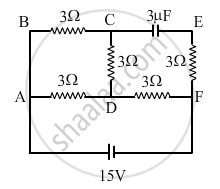
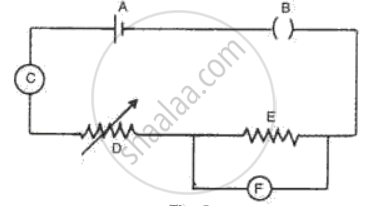
Fig. represents the circuit used for the verification of Ohm's law. Label the parts from A to F. state the function of each.
What is meant by the drift speed of free electrons?
Answer the following question.
Distinguish between Ohmic and non-ohmic substances; explain with the help of example.
The variable resistance is called ____________.
The mathematical form of Ohm's Law is:
