Advertisements
Advertisements
प्रश्न
When a 12 V battery is connected across an unknown resistor, there is a current of 2.5 mA in the circuit. Find the value of the resistance of the resistor.
Advertisements
उत्तर
Voltage V = 12 V
current flowing in the circuit I = 2.5 mA = 2.5 × 10⁻³ A
∴ Resistance (R) = `"V"/"I"`
= `12/(2.5 xx 10^-3)`
R = `(12 xx 10^3)/25`
R = 4800 Ω
R = `4800/1000` KΩ
R = 4.8 KΩ
APPEARS IN
संबंधित प्रश्न
Find the resistance of a conductor if 0.24 A current is passing through it and a potential difference of 24 V is applied across it.
Why are coils of electric toasters and electric irons made of an alloy rather than a pure metal?
Find the expression for the resistivity of a material and state the SI unit of resistivity.
Name the law which is illustrated by the above V−I graph.
What is the necessary condition for a conductor to obey Ohm’s law?
An electric bulb draws 1.2 A current at 6.0 V. Find the resistance of filament of bulb while glowing.
How does an increase in the temperature affect the specific resistance of a semiconductor?
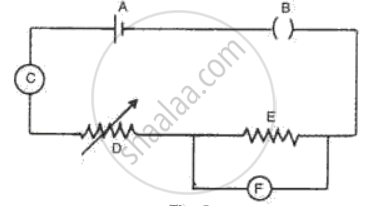
Fig. represents the circuit used for the verification of Ohm's law. Label the parts from A to F. state the function of each.
Rewrite the following statement by selecting the correct option.
The S.I. unit of resistance is __________.
State Ohm’s law.
Two cells each of 5V are connected in series across an 8Ω resistor and three parallel resistors of 4Ω, 6Ω, and 12Ω. Draw a circuit diagram for the above arrangement. Calculate
- the current drawn from the cell
- current through each resistor
The slope of voltage (V) versus current (I) is called:

A heater of 220 V heats a volume of water m 5 mint time. A heater of 110 V heat in ten second. The resistance of the conductor is
Suppose there is a circuit consisting of only resistances and batteries and we have to double (or increase it to n-times) all voltages and all resistances. Show that currents are unaltered. Do this for circuit of Example 3.7 in the NCERT Text Book for Class XII.
Why should an ammeter have low resistance?
A current of 0.8 A flows in a conductor of 40 Ω for 1 minute. The heat produced in the conductor will be ______.
A current of 3.2 mA flows through a conductor. If charge on an electron is −1.6 × 10⁻¹⁹ coulomb, find the number of electrons that will pass each second through the cross section of that conductor.
Ohm's Law states that for a metallic conductor, the current flowing through it is directly proportional to the potential difference across its ends, provided that:
Which of the following describes the V-I relation for an Ohmic conductor?
If the voltage across a conductor is increased while its temperature remains unchanged, what happens to the current flowing through it?
