Advertisements
Advertisements
प्रश्न
When a 12 V battery is connected across an unknown resistor, there is a current of 2.5 mA in the circuit. Find the value of the resistance of the resistor.
Advertisements
उत्तर
Voltage V = 12 V
current flowing in the circuit I = 2.5 mA = 2.5 × 10⁻³ A
∴ Resistance (R) = `"V"/"I"`
= `12/(2.5 xx 10^-3)`
R = `(12 xx 10^3)/25`
R = 4800 Ω
R = `4800/1000` KΩ
R = 4.8 KΩ
APPEARS IN
संबंधित प्रश्न
If the potential difference across the ends of a conductor is 220 V and the resistance of the conductor is 44 Ω (ohm), then the current flowing through is _________.
- 0.2 A
- 0.5 A
- 2 A
- 5 A
What is Resistivity?
The resistors R1, R2, R3 and R4 in the figure given below are all equal in value.
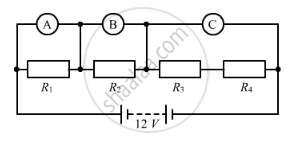
What would you expect the voltmeter A, B and C to read assuming that the connecting wires in the circuit have negligible resistance?
A resistance of 40 ohms and one of 60 ohms are arranged in series across 220 volt supply. Find the heat in joules produced by this combination of resistances in half a minute.
How would you connect two resistors in series? Draw a diagram. Calculate the total equivalent resistance.
What is meant by the drift speed of free electrons?
Answer the following question.
Distinguish between Ohmic and non-ohmic substances; explain with the help of example.
Ohm’s law states the relationship between power and voltage.
What is ohmic device?
Obtain the macroscopic form of Ohm’s law from its microscopic form and discuss its limitation.
Explain the equivalent resistance of a series resistor network.
The unit of specific resistance is ____________.
You are provided with a resistor, a key, an ammeter, a voltmeter, four cells of 1.5 V each and few connecting wires. Using circuit components, draw a labelled circuit diagram to show the setup to study Ohm's law.
State the relationship between potential difference (V) across the resistor and the current (I) flowing through it. Also draw V-I graph, taking V on the X-axis.
A current of 0.8 A flows in a conductor of 40 Ω for 1 minute. The heat produced in the conductor will be ______.
A current of 3.2 mA flows through a conductor. If charge on an electron is −1.6 × 10⁻¹⁹ coulomb, find the number of electrons that will pass each second through the cross section of that conductor.
Which of the following correctly defines Potential Difference (V) as one of the three core quantities of Ohm's Law?
When two conductors at different electric potentials are joined by a metallic wire, in which direction do the electrons flow?
For a continuous current flow through a conductor, what must be maintained across the ends of the conductor?
Which of the following is an example of a Non-Ohmic material?
