Advertisements
Advertisements
प्रश्न
The resistors R1, R2, R3 and R4 in the figure given below are all equal in value.
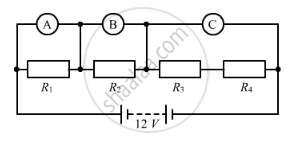
What would you expect the voltmeter A, B and C to read assuming that the connecting wires in the circuit have negligible resistance?
Advertisements
उत्तर
The p.d across all the resistors R1, R2, R3 and R4 is 12 V.
Since all the resistors are of the same value, the p.d at exactly half of the combination, i.e. the voltage shown by the voltmeter C will be 6 V. Similarly, the p.d. shown by the voltmeters A and B is one-fourth the p.d. across all the resistors. Therefore, A and B will have a reading of 3 V.
APPEARS IN
संबंधित प्रश्न
Let the resistance of an electrical component remains constant while the potential difference across the two ends of the component decreases to half of its former value. What change will occur in the current through it?
When a 12 V battery is connected across an unknown resistor, there is a current of 2.5 mA in the circuit. Find the value of the resistance of the resistor.
A low voltage supply from which one needs high currents must have very low internal resistance. Why?
Write the SI unit of resistivity
Find the expression for the resistivity of a material and state the SI unit of resistivity.
What is the necessary condition for a conductor to obey Ohm’s law?
- Draw a V-I graph for a conductor obeying Ohm’s law.
- What does the slope of V–I graph for a conductor represent?
A wire of resistance 3 ohm and length 10 cm is stretched to length 30 cm. Assuming that it has a uniform cross section, what will be its new resistance?
How does an increase in the temperature affect the specific resistance of a semiconductor?
Define the following:
Coulomb
SI unit of resistance is:
State macroscopic form of Ohm’s law.
What is ohmic device?
Write a short note on superconductors?
Which of the following is correct for V-I graph of a good conductor?
Ohm's law deals with the relationship between ______
Two conductors are made of the same material and have the same length. Conductor A is a solid wire of diameter 1 mm. Conductor B is a hollow tube of outer diameter 2 mm and inner diameter 1 mm. Find the ratio of resistance RA to RB.
A resistor is connected in a circuit with a voltage of 12 V and a resistance of 24 Ω. What is the current flowing through the resistor?
