Advertisements
Advertisements
Question
The resistors R1, R2, R3 and R4 in the figure given below are all equal in value.
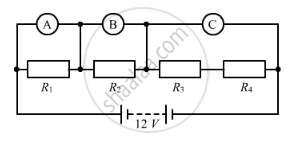
What would you expect the voltmeter A, B and C to read assuming that the connecting wires in the circuit have negligible resistance?
Advertisements
Solution
The p.d across all the resistors R1, R2, R3 and R4 is 12 V.
Since all the resistors are of the same value, the p.d at exactly half of the combination, i.e. the voltage shown by the voltmeter C will be 6 V. Similarly, the p.d. shown by the voltmeters A and B is one-fourth the p.d. across all the resistors. Therefore, A and B will have a reading of 3 V.
APPEARS IN
RELATED QUESTIONS
What is Resistivity?
Write the formula of resistivity
Name the physical quantity whose unit is "ohm".
Ohm's law gives a relationship between:
(a) current and resistance
(b) resistance and potential difference
(c) potential difference and electric charge
(d) current and potential difference
In a conductor 6.25 × `10^16` electrons flow from its end A to B in 2 s. Find the current flowing through the conductor (e = 1.6 × `10^-19` C)
An electric bulb draws 1.2 A current at 6.0 V. Find the resistance of filament of bulb while glowing.
A car bulb connected to a 12 volt battery draws 2 A current when glowing. What is the resistance of the filament of the bulb? Will the resistance be more same or less when the bulb is not glowing?
A wire of resistance 3 ohm and length 10 cm is stretched to length 30 cm. Assuming that it has a uniform cross section, what will be its new resistance?
A wire of resistance 9 ohm having length 30 cm is tripled on itself. What is its new resistance?
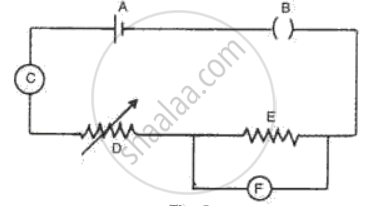
Fig. represents the circuit used for the verification of Ohm's law. Label the parts from A to F. state the function of each.
Define ampere and volt with respect to Ohm’s law.
SI unit of resistance is:
State microscopic form of Ohm’s law.
Write a short note on superconductors?
The slope of voltage (V) versus current (I) is called:

The variable resistance is called ____________.
A student carries out an experiment and plots the V-I graph of three samples of nichrome wire with resistances R1, R2 and R3 respectively. Which of the following is true?

Suppose there is a circuit consisting of only resistances and batteries and we have to double (or increase it to n-times) all voltages and all resistances. Show that currents are unaltered. Do this for circuit of Example 3.7 in the NCERT Text Book for Class XII.
The resistance of a resistor is reduced to half of its initial value. If other parameters of the electrical circuit remain unaltered, the amount of heat produced in the resistor will become ______.
The mathematical form of Ohm's Law is:
