Advertisements
Advertisements
Question
Name the physical quantity whose unit is "ohm".
Advertisements
Solution
Electrical resistance is the physical quantity whose SI unit is ohm.
APPEARS IN
RELATED QUESTIONS
Find the resistance of a conductor if 0.24 A current is passing through it and a potential difference of 24 V is applied across it.
Let the resistance of an electrical component remains constant while the potential difference across the two ends of the component decreases to half of its former value. What change will occur in the current through it?
Write the SI unit of resistivity
The unit of electrical resistance is:
(a) ampere
(b) volt
(c) coulomb
(d) ohm
The graph between V and I for a conductor is a straight line passing through the origin.
- Which law is illustrated by such a graph?
- What should remain constant in a statement of this law?
The resistors R1, R2, R3 and R4 in the figure given below are all equal in value.
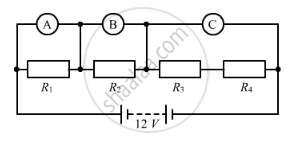
What would you expect the voltmeter A, B and C to read assuming that the connecting wires in the circuit have negligible resistance?
How much energy is consumed when a current of 5 amperes flows through the filament (or element) of a heater having resistance of 100 ohms for two hours? Express it in joules.
In a conductor 6.25 × `10^16` electrons flow from its end A to B in 2 s. Find the current flowing through the conductor (e = 1.6 × `10^-19` C)
The filament of a bulb takes a current 100 mA when potential difference across it is 0.2 V. When the potential difference across it becomes 1.0 V, the current becomes 400 mA. Calculate the resistance of filament in each case and account for the difference.
Define ampere and volt with respect to Ohm’s law.
Draw a neat diagram for the verification of Ohm’s law by voltmeter-ammeter method. By another diagram show the relation between p.d. and current.
Choose the correct alternative.
Which of the following is an ohmic conductor?
The ratio of the potential difference to the current is known as ________.
Explain the equivalent resistance of a parallel resistor network.
Assertion: The statement of Ohm’s law is K = IR.
Reason: V = IR is the equation which defines resistance.
You are provided with a resistor, a key, an ammeter, a voltmeter, four cells of 1.5 V each and few connecting wires. Using circuit components, draw a labelled circuit diagram to show the setup to study Ohm's law.
State the relationship between potential difference (V) across the resistor and the current (I) flowing through it. Also draw V-I graph, taking V on the X-axis.
Which of the following correctly defines Potential Difference (V) as one of the three core quantities of Ohm's Law?
In the context of Ohm's Law, Current (I) is defined as:
If a current of 1 A flows through a conductor, then according to Ohm's Law, the resistance of the conductor is:
