Advertisements
Advertisements
Question
Name the unit of electrical resistance and give its symbol.
Advertisements
Solution
The SI unit of electrical resistance is ohm and its symbol is Ω.
APPEARS IN
RELATED QUESTIONS
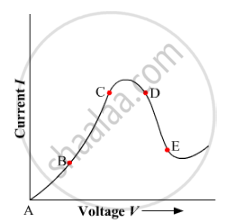
Graph showing the variation of current versus voltage for a material Ga As is shown in the figure. Identify the region of
(i) negative resistance
(ii) where Ohm's law is obeyed.
An electrical bulb is marked 200V, 100W. Calculate the electrical resistance of its filament. If five such
bulbs are connected in series to a 200V supply, how much current will flow through them?
Ohm's law gives a relationship between:
(a) current and resistance
(b) resistance and potential difference
(c) potential difference and electric charge
(d) current and potential difference
State Ohm’s law and draw a neat labelled circuit diagram containing a battery, a key, a voltmeter, an ammeter, a rheostat and an unknown resistance to verify it.
What is the necessary condition for a conductor to obey Ohm’s law?
A wire of resistance 9 ohm having length 30 cm is tripled on itself. What is its new resistance?
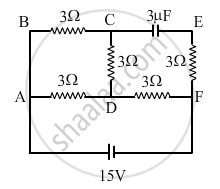
In the circuit shown in the figure, find the total resistance of the circuit and the current in the arm AD.
- Name and state the law which relates the potential difference and current in a conductor.
- What is the necessary condition for a conductor to obey the law named above in part (a) ?
State the limitations of Ohm’s law.
Draw a neat diagram for the verification of Ohm’s law by voltmeter-ammeter method. By another diagram show the relation between p.d. and current.
Choose the correct alternative.
Which of the following is an ohmic conductor?
The ratio of the potential difference to the current is known as ________.
A wire connected to a power supply of 230 V has power dissipation P1. Suppose the wire is cut into two equal pieces and connected parallel to the same power supply. In this case, power dissipation is P2. The ratio of `"P"_2/"P"_1` is
What is non ohmic device?
Define temperature coefficient of resistance.
Which of the following I-V graph represents ohmic conductors?
The temperature of a conductor is increased. The graph best showing the variation of its resistance is:
Consider a current carrying wire (current I) in the shape of a circle. Note that as the current progresses along the wire, the direction of j (current density) changes in an exact manner, while the current I remain unaffected. The agent that is essentially responsible for is ______.
The electric current between two joined conductors at different potentials continues to flow until:
For a continuous current flow through a conductor, what must be maintained across the ends of the conductor?
