Advertisements
Advertisements
Question
A wire connected to a power supply of 230 V has power dissipation P1. Suppose the wire is cut into two equal pieces and connected parallel to the same power supply. In this case, power dissipation is P2. The ratio of `"P"_2/"P"_1` is
Options
1
2
3
4
Advertisements
Solution
4
APPEARS IN
RELATED QUESTIONS
Write the SI unit of resistivity
Calculate the current flowing through a wire of resistance 5 Ω connected to a battery of potential difference 3 V.
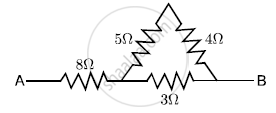
Calculate the effective resistance across AB?
A metal sphere is kept on an insulting stands. A negatively charged rod is brought near it, then the sphere is earthed as shown. On removing the earthing, and taking the negatively charged rod away, what will be the nature of charge on the sphere? Give reason for your answer.

The unit of specific resistance is ____________.
The variable resistance is called ____________.
A heater of 220 V heats a volume of water m 5 mint time. A heater of 110 V heat in ten second. The resistance of the conductor is
In the context of Ohm's Law, Current (I) is defined as:
Which of the following is an example of a Non-Ohmic material?
