Advertisements
Advertisements
Question
Calculate the effective resistance across AB?
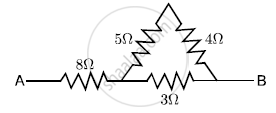
Advertisements
Solution
5 Ω and 4Ω are in series
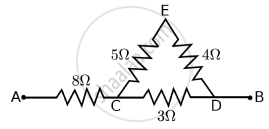
∴ R1 = (5 + 4)Ω = 9Ω
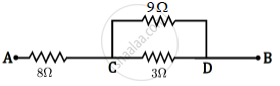
Now, 9Ω and 3Ω are in parallel
`therefore R_2 = (9 xx 3)/(9+3)=9/4Ω`
Now, 2 8Ω and R2 are in series
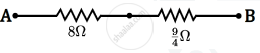
`therefore R_3 = 8 +9/4 =41/4 Ω= 10.25Ω`
APPEARS IN
RELATED QUESTIONS
A low voltage supply from which one needs high currents must have very low internal resistance. Why?
Ohm's law gives a relationship between:
(a) current and resistance
(b) resistance and potential difference
(c) potential difference and electric charge
(d) current and potential difference
In the circuit shown below in Fig, calculate the value of x if the equivalent resistance between A and B is 4 Ω.

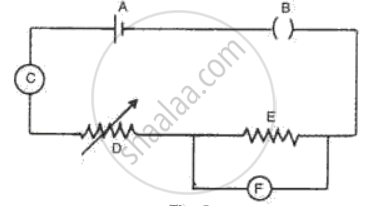
Fig. represents the circuit used for the verification of Ohm's law. Label the parts from A to F. state the function of each.
State the limitations of Ohm’s law.
Define Current density.
A student carries out an experiment and plots the V-I graph of three samples of nichrome wire with resistances R1, R2 and R3 respectively. Which of the following is true?

A current of 2amp flowing through a conductor produced 80 joule of heat in 10 sec. The resistance of the conductor is:-
How is electric current related to the potential difference across the terminals of a conductor?
Draw a labelled circuit diagram to verify this relationship.
Resistance (R) in a conductor is best described as:
