Advertisements
Advertisements
Question
The graph between V and I for a conductor is a straight line passing through the origin.
What should remain constant in a statement of this law?
Advertisements
Solution
Ohm's law is true only if the temperature of the conductor is constant.
RELATED QUESTIONS
What is Resistivity?
Find the expression for the resistivity of a material and state the SI unit of resistivity.
Fill in the following blank with suitable words:
Resistance is measured in .............. The resistance of a wire increases as the length ..............; as the temperature ..............; and as the cross-sectional area .............. .
How much energy is consumed when a current of 5 amperes flows through the filament (or element) of a heater having resistance of 100 ohms for two hours? Express it in joules.
A wire of resistance 9 ohm having length 30 cm is tripled on itself. What is its new resistance?
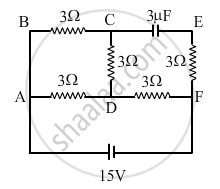
In the circuit shown in the figure, find the total resistance of the circuit and the current in the arm AD.
Calculate the electric field in a copper wire of cross-sectional area 2.0 mm2 carrying a current of 1 A.
The resistivity of copper = 1.7 × 10⁻⁸ Ω m
Calculate the effective resistance across AB?
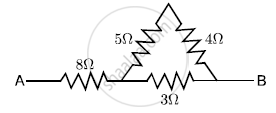
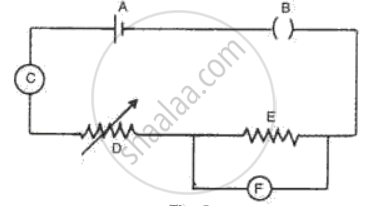
Fig. represents the circuit used for the verification of Ohm's law. Label the parts from A to F. state the function of each.
- Name and state the law which relates the potential difference and current in a conductor.
- What is the necessary condition for a conductor to obey the law named above in part (a) ?
What are ohmic conductors? Give one exmaple. Draw a graph showing the current-voltage relationship for an ohmic conductor.
What is non ohmic device?
Which of the following I-V graph represents ohmic conductors?
A student carries out an experiment and plots the V-I graph of three samples of nichrome wire with resistances R1, R2 and R3 respectively. Which of the following is hue?

Consider a current carrying wire (current I) in the shape of a circle. Note that as the current progresses along the wire, the direction of j (current density) changes in an exact manner, while the current I remain unaffected. The agent that is essentially responsible for is ______.
A metal rod of length 10 cm and a rectangular cross-section of 1 cm × `1/2` cm is connected to a battery across opposite faces. The resistance will be ______.
State Ohm's Law. Represent it mathematically.
What is the resistance of a conductor through which a current of 0.5 A flows when a potential difference of 2V is applied across its ends?
The circuit depicted in the figure is employed for studying Ohm’s Law. Instead of using a standard resistor, a student opts for a glass tube filled with mercury (tube 1), connected to the circuit through two electrodes, E1 and E2. He records the readings of the ammeter and voltmeter, thereby calculating the resistance. The student repeats the experiment by substituting tube 1 with tube 2, where the same amount of mercury fills tube 2.
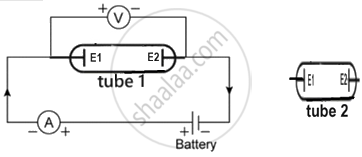
Neglecting internal resistance of the cell use (> or < or =) to compare:
- the resistance in both the cases.
- the voltmeter readings in both the cases.
- the specific resistance in both the cases.
