Advertisements
Advertisements
Question

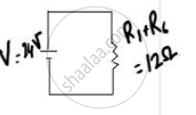
Calculate the total resistance of the circuit and find the total current in the circuit.
Advertisements
Solution


R3 and R4 are in series, hence the equivalent resistance of those two = R5 = R3 + R4 = 10 ohms
R5 and R2 are in parallel, Let R6 be the equivalent resistance for them. Hence R6 = (R5 × R2)/(R5 + R2) = 100/20 = 5 ohms
Now R1 and R6 are in series and hence the final equivalent resistance of the entire circuit is R = R1 + R6 = 12 ohms
By Ohm's Law we know that V = IR, hence I = V/R.
Hence the current in the circuit is 24/12 A = 2A
APPEARS IN
RELATED QUESTIONS
If the potential difference across the ends of a conductor is 220 V and the resistance of the conductor is 44 Ω (ohm), then the current flowing through is _________.
- 0.2 A
- 0.5 A
- 2 A
- 5 A
What is an Ohmic resistor?
Write the formula of resistivity
State Ohm’s law and draw a neat labelled circuit diagram containing a battery, a key, a voltmeter, an ammeter, a rheostat and an unknown resistance to verify it.
An electric bulb draws 1.2 A current at 6.0 V. Find the resistance of filament of bulb while glowing.
Rewrite the following statement by selecting the correct option.
The S.I. unit of resistance is __________.
What are ohmic conductors? Give one exmaple. Draw a graph showing the current-voltage relationship for an ohmic conductor.
The ratio of the potential difference to the current is known as ________.
A student carries out an experiment and plots the V-I graph of three samples of nichrome wire with resistances R1, R2 and R3 respectively. Which of the following is true?

The resistance of a resistor is reduced to half of its initial value. If other parameters of the electrical circuit remain unaltered, the amount of heat produced in the resistor will become ______.