Advertisements
Advertisements
प्रश्न

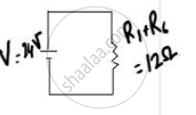
Calculate the total resistance of the circuit and find the total current in the circuit.
Advertisements
उत्तर


R3 and R4 are in series, hence the equivalent resistance of those two = R5 = R3 + R4 = 10 ohms
R5 and R2 are in parallel, Let R6 be the equivalent resistance for them. Hence R6 = (R5 × R2)/(R5 + R2) = 100/20 = 5 ohms
Now R1 and R6 are in series and hence the final equivalent resistance of the entire circuit is R = R1 + R6 = 12 ohms
By Ohm's Law we know that V = IR, hence I = V/R.
Hence the current in the circuit is 24/12 A = 2A
APPEARS IN
संबंधित प्रश्न
Find the resistance of a conductor if 0.24 A current is passing through it and a potential difference of 24 V is applied across it.
Name the unit of electrical resistance and give its symbol.
State the relation correlating the electric current flowing in a conductor and the voltage applied across it. Also, draw a graph to show this. relationship.
Ohm’s law states the relationship between power and voltage.
State macroscopic form of Ohm’s law.
The slope of voltage (V) versus current (I) is called:

A student carries out an experiment and plots the V-I graph of three samples of nichrome wire with resistances R1, R2 and R3 respectively. Which of the following is hue?

State Ohm's Law. Represent it mathematically.
You are provided with a resistor, a key, an ammeter, a voltmeter, four cells of 1.5 V each and few connecting wires. Using circuit components, draw a labelled circuit diagram to show the setup to study Ohm's law.
State the relationship between potential difference (V) across the resistor and the current (I) flowing through it. Also draw V-I graph, taking V on the X-axis.