Advertisements
Advertisements
प्रश्न

Calculate the total resistance of the circuit and find the total current in the circuit.
Advertisements
उत्तर

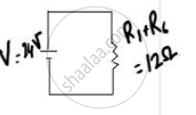
R3 and R4 are in series, hence the equivalent resistance of those two = R5 = R3 + R4 = 10 ohms
R5 and R2 are in parallel, Let R6 be the equivalent resistance for them. Hence R6 = (R5 × R2)/(R5 + R2) = 100/20 = 5 ohms
Now R1 and R6 are in series and hence the final equivalent resistance of the entire circuit is R = R1 + R6 = 12 ohms
By Ohm's Law we know that V = IR, hence I = V/R.
Hence the current in the circuit is 24/12 A = 2A
APPEARS IN
संबंधित प्रश्न
A low voltage supply from which one needs high currents must have very low internal resistance. Why?
What is an Ohmic resistor?
Name the law which is illustrated by the above V−I graph.
A wire of resistance 3 ohm and length 10 cm is stretched to length 30 cm. Assuming that it has a uniform cross section, what will be its new resistance?
What length of copper wire of resistivity 1.7 × 10⁻⁸ Ω m and radius 1 mm is required so that its resistance is 2Ω?
In the circuit shown below in Fig, calculate the value of x if the equivalent resistance between A and B is 4 Ω.

State microscopic form of Ohm’s law.
A student carries out an experiment and plots the V-I graph of three samples of nichrome wire with resistances R1, R2 and R3 respectively. Which of the following is true?

Ohm's Law states that for a metallic conductor, the current flowing through it is directly proportional to the potential difference across its ends, provided that:
