Advertisements
Advertisements
प्रश्न
Name the unit of electrical resistance and give its symbol.
Advertisements
उत्तर
The SI unit of electrical resistance is ohm and its symbol is Ω.
APPEARS IN
संबंधित प्रश्न
If the potential difference across the ends of a conductor is 220 V and the resistance of the conductor is 44 Ω (ohm), then the current flowing through is _________.
- 0.2 A
- 0.5 A
- 2 A
- 5 A
Find the resistance of a conductor if 0.24 A current is passing through it and a potential difference of 24 V is applied across it.
How much energy is consumed when a current of 5 amperes flows through the filament (or element) of a heater having resistance of 100 ohms for two hours? Express it in joules.
State Ohm’s law and draw a neat labelled circuit diagram containing a battery, a key, a voltmeter, an ammeter, a rheostat and an unknown resistance to verify it.
What is the necessary condition for a conductor to obey Ohm’s law?
What length of copper wire of resistivity 1.7 × 10⁻⁸ Ω m and radius 1 mm is required so that its resistance is 2Ω?
In the circuit shown below in Fig, calculate the value of x if the equivalent resistance between A and B is 4 Ω.

Choose the correct alternative.
Which of the following is an ohmic conductor?
Define temperature coefficient of resistance.
Write a short note on superconductors?
Obtain the macroscopic form of Ohm’s law from its microscopic form and discuss its limitation.
Two conductors are made of the same material and have the same length. Conductor A is a solid wire of diameter 1 mm. Conductor B is a hollow tube of outer diameter 2 mm and inner diameter 1 mm. Find the ratio of resistance RA to RB.
Let the resistance of an electrical device remain constant, while the potential difference across its two ends decreases to one fourth of its initial value. What change will occur in the current through it? State the law which helps us in solving the above stated question.
How is electric current related to the potential difference across the terminals of a conductor?
Draw a labelled circuit diagram to verify this relationship.
The circuit depicted in the figure is employed for studying Ohm’s Law. Instead of using a standard resistor, a student opts for a glass tube filled with mercury (tube 1), connected to the circuit through two electrodes, E1 and E2. He records the readings of the ammeter and voltmeter, thereby calculating the resistance. The student repeats the experiment by substituting tube 1 with tube 2, where the same amount of mercury fills tube 2.
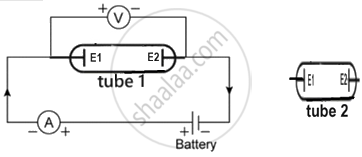
Neglecting internal resistance of the cell use (> or < or =) to compare:
- the resistance in both the cases.
- the voltmeter readings in both the cases.
- the specific resistance in both the cases.
Resistance (R) in a conductor is best described as:
Which of the following describes the V-I relation for an Ohmic conductor?
