Advertisements
Advertisements
प्रश्न
Define temperature coefficient of resistance.
Advertisements
उत्तर
The temperature coefficient is defined as the ratio of the increase in resistivity per degree rise in temperature to its resistivity at T0.
APPEARS IN
संबंधित प्रश्न
In the circuit shown below in Fig, calculate the value of x if the equivalent resistance between A and B is 4 Ω.

A wire has a length of 2.0 m and a resistance of 5.0 Ω. Find the electric field existing inside the wire if it carries a current of 10 A.
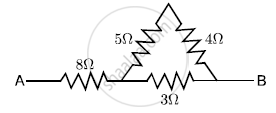
Calculate the effective resistance across AB?
- Name and state the law which relates the potential difference and current in a conductor.
- What is the necessary condition for a conductor to obey the law named above in part (a) ?
Answer the following question.
Distinguish between Ohmic and non-ohmic substances; explain with the help of example.
Ohm’s law states the relationship between power and voltage.
Ohm's law deals with the relationship between ______
Consider a current carrying wire (current I) in the shape of a circle. Note that as the current progresses along the wire, the direction of j (current density) changes in an exact manner, while the current I remain unaffected. The agent that is essentially responsible for is ______.
The circuit depicted in the figure is employed for studying Ohm’s Law. Instead of using a standard resistor, a student opts for a glass tube filled with mercury (tube 1), connected to the circuit through two electrodes, E1 and E2. He records the readings of the ammeter and voltmeter, thereby calculating the resistance. The student repeats the experiment by substituting tube 1 with tube 2, where the same amount of mercury fills tube 2.
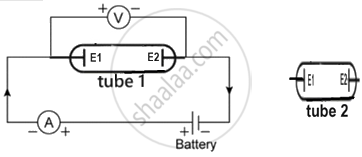
Neglecting internal resistance of the cell use (> or < or =) to compare:
- the resistance in both the cases.
- the voltmeter readings in both the cases.
- the specific resistance in both the cases.
The mathematical form of Ohm's Law is:
