Advertisements
Advertisements
प्रश्न
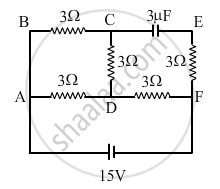
In the circuit shown in the figure, find the total resistance of the circuit and the current in the arm AD.
Advertisements
उत्तर
Since the capacitor will act as an open circuit here, the arm CE and EF will become ineffective. The circuit is now reduced to as below
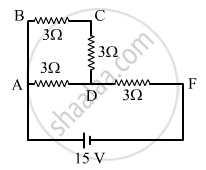
Effective resistance across AD = (BC + CD) ∥ AD
= \[\left( 3 + 3 \right) \lVert 3 = 2 \Omega\]
Total resistance of the circuit = AD + DF = 2 + 3 = 5 Ω
Total current in the circuit = \[\frac{15}{5} = 3 A\]
The current through AD and BCD will divide in the inverse ratio of the resistance.
∴ Current through AD = \[3 \times \frac{6}{\left( 6 + 3 \right)} = 3 \times \frac{6}{9} = 2 A\]
APPEARS IN
संबंधित प्रश्न
If the potential difference across the ends of a conductor is 220 V and the resistance of the conductor is 44 Ω (ohm), then the current flowing through is _________.
- 0.2 A
- 0.5 A
- 2 A
- 5 A
A resistance of 40 ohms and one of 60 ohms are arranged in series across 220 volt supply. Find the heat in joules produced by this combination of resistances in half a minute.
State Ohm’s law and draw a neat labelled circuit diagram containing a battery, a key, a voltmeter, an ammeter, a rheostat and an unknown resistance to verify it.
- Draw a V-I graph for a conductor obeying Ohm’s law.
- What does the slope of V–I graph for a conductor represent?
A wire of resistance 9 ohm having length 30 cm is tripled on itself. What is its new resistance?
What is meant by the drift speed of free electrons?
Rewrite the following statement by selecting the correct option.
The S.I. unit of resistance is __________.
The resistance of a nichrome wire at 0°C is 10Ω. If its temperature coefficient of resistivity of nichrome is 0.004/ °C, find its resistance of the wire at boiling point of water. Comment on the result.
What is the resistance of a conductor through which a current of 0.5 A flows when a potential difference of 2V is applied across its ends?
From Ohm's Law, since \[I \propto V\], the constant ratio \[\frac{V}{I}\] is defined as:
