Advertisements
Advertisements
प्रश्न
- Draw a V-I graph for a conductor obeying Ohm’s law.
- What does the slope of V–I graph for a conductor represent?
Advertisements
उत्तर

-
Use the Y-axis to plot V against I, and the X-axis to plot I. As can be seen in the illustration, the graphs are determined to be straight lines. So, the ohm law is confirmed.
APPEARS IN
संबंधित प्रश्न
Will current flow more easily through a thick wire or a thin wire of the same material, when connected to the same source? Why?
The unit of electrical resistance is:
(a) ampere
(b) volt
(c) coulomb
(d) ohm
State Ohm’s law and draw a neat labelled circuit diagram containing a battery, a key, a voltmeter, an ammeter, a rheostat and an unknown resistance to verify it.
In an experiment of verification of Ohm’s law following observations are obtained.
|
Potential difference V (in volt) |
0.5 | 1.0 | 1.5 | 2.0 | 2.5 |
| current I (in ampere) | 0.2 | 0.4 | 0.6 | 0.8 | 1.0 |
Draw a V-I graph and use this graph to find:
- the potential difference V when the current I is 0.5 A,
- the current I when the potential difference V is 0.75 V,
- the resistance in a circuit.
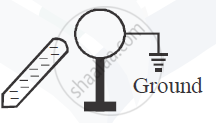
A metal sphere is kept on an insulting stands. A negatively charged rod is brought near it, then the sphere is earthed as shown. On removing the earthing, and taking the negatively charged rod away, what will be the nature of charge on the sphere? Give reason for your answer.
State microscopic form of Ohm’s law.
Which of the following I-V graph represents ohmic conductors?
A student carries out an experiment and plots the V-I graph of three samples of nichrome wire with resistances R1, R2 and R3 respectively. Which of the following is hue?

What is the resistance of a conductor through which a current of 0.5 A flows when a potential difference of 2V is applied across its ends?
Which formula is used with Ohm's Law to help determine power consumption in an electrical circuit?
