Advertisements
Advertisements
प्रश्न
- Name and state the law which relates the potential difference and current in a conductor.
- What is the necessary condition for a conductor to obey the law named above in part (a) ?
Advertisements
उत्तर
- The law is called Ohm's law. It states that the current flowing through the conductor is directly proportional to the potential difference across the ends of the conductor, given that the temperature remains constant.
- The temperature should remain constant.
APPEARS IN
संबंधित प्रश्न
A resistance of 40 ohms and one of 60 ohms are arranged in series across 220 volt supply. Find the heat in joules produced by this combination of resistances in half a minute.
Define the following:
Coulomb
Ohm’s law states the relationship between power and voltage.
Define Current density.
State microscopic form of Ohm’s law.
What is ohmic device?
What is meant by resistance of a conductor ? Define its SI unit.
The circuit depicted in the figure is employed for studying Ohm’s Law. Instead of using a standard resistor, a student opts for a glass tube filled with mercury (tube 1), connected to the circuit through two electrodes, E1 and E2. He records the readings of the ammeter and voltmeter, thereby calculating the resistance. The student repeats the experiment by substituting tube 1 with tube 2, where the same amount of mercury fills tube 2.
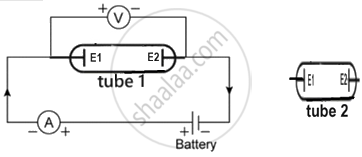
Neglecting internal resistance of the cell use (> or < or =) to compare:
- the resistance in both the cases.
- the voltmeter readings in both the cases.
- the specific resistance in both the cases.
Which of the following correctly defines Potential Difference (V) as one of the three core quantities of Ohm's Law?
Which of the following is an example of a Non-Ohmic material?
