Advertisements
Advertisements
प्रश्न
State Ohm’s law and draw a neat labelled circuit diagram containing a battery, a key, a voltmeter, an ammeter, a rheostat and an unknown resistance to verify it.
Advertisements
उत्तर
It states that electric current flowing through a metallic wire is directly proportional to the potential difference V across its ends provided its temperature remains the same. This is called Ohm's law.
V = IR
Experimental Verification: Reassemble the circuit according to the diagram. The circuit consists of a battery, an unknown resistance, a voltmeter with its positive terminal facing the battery's anode, and a rheostat and ammeter connected in series. With the key closed, and the rheostat set to zero, the ammeter and voltmeter should display the lowest possible readings. After that, the rheostat is adjusted step-by-step, and the values of A and V are recorded at each interval. The ratio of `"V"/"I"` is always found to be constant. This verifies Ohm's Law.

The temperature and other physical parameters of the conductor must be kept constant.
APPEARS IN
संबंधित प्रश्न
What is an Ohmic resistor?
In the circuit shown in the figure, find the total resistance of the circuit and the current in the arm AD.
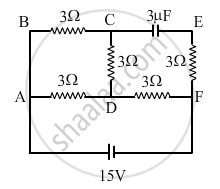
What are non-ohmic conductors? Give one exmaple. Draw a current-voltage graph for a non-ohmic conductor.
The ratio of the potential difference to the current is known as ________.
Write a short note on superconductors?
The variable resistance is called ____________.
A metal rod of length 10 cm and a rectangular cross-section of 1 cm × `1/2` cm is connected to a battery across opposite faces. The resistance will be ______.
The voltage - current readings of a certain material are shown in the table given below:
| Voltage (V) | 10 V | 20 V | 30 V |
| Current (I) | 2 A | 3 A | 4 A |
Study the table.
- State whether the conductor used is ohmic or non-ohmic.
- Justify your answer.
- State Ohm's law.
For a continuous current flow through a conductor, what must be maintained across the ends of the conductor?
