Advertisements
Advertisements
प्रश्न
A car bulb connected to a 12 volt battery draws 2 A current when glowing. What is the resistance of the filament of the bulb? Will the resistance be more same or less when the bulb is not glowing?
Advertisements
उत्तर
Potential Difference/Voltage (V) = 12 V
Current (I) = 2 A
Resistance (R) = ?
According to Ohm's Law:
V = IR
Then R = `"V"/"I"`
R = `12 / 2`
R = 6 Ω
Resistance will be less when the bulb is not glowing.
APPEARS IN
संबंधित प्रश्न
How much energy is consumed when a current of 5 amperes flows through the filament (or element) of a heater having resistance of 100 ohms for two hours? Express it in joules.
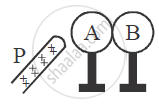
Two metallic spheres A and B kept on insulating stands are in contact with each other. A positively charged rod P is brought near the sphere A as shown in the figure. The two spheres are separated from each other, and the rod P is removed. What will be the nature of charges on spheres A and B?
Define ampere and volt with respect to Ohm’s law.
State macroscopic form of Ohm’s law.
Define temperature coefficient of resistance.
State Ohm's Law. Represent it mathematically.
Let the resistance of an electrical device remain constant, while the potential difference across its two ends decreases to one fourth of its initial value. What change will occur in the current through it? State the law which helps us in solving the above stated question.
A current of 3.2 mA flows through a conductor. If charge on an electron is −1.6 × 10⁻¹⁹ coulomb, find the number of electrons that will pass each second through the cross section of that conductor.
When two conductors at different electric potentials are joined by a metallic wire, in which direction do the electrons flow?
Which formula is used with Ohm's Law to help determine power consumption in an electrical circuit?
