Advertisements
Advertisements
प्रश्न
What is the resistance of a conductor through which a current of 0.5 A flows when a potential difference of 2V is applied across its ends?
Advertisements
उत्तर
Given, I = 0.5 A
Potential difference, V = 2 V
Applying ohm's law, V = IR
Or, R = `"V"/"I" = 2/0.5 = 4 Omega`
Hence, the resistance of a conductor is 4 Ω.
APPEARS IN
संबंधित प्रश्न
What is Resistivity?
In an experiment of verification of Ohm’s law following observations are obtained.
|
Potential difference V (in volt) |
0.5 | 1.0 | 1.5 | 2.0 | 2.5 |
| current I (in ampere) | 0.2 | 0.4 | 0.6 | 0.8 | 1.0 |
Draw a V-I graph and use this graph to find:
- the potential difference V when the current I is 0.5 A,
- the current I when the potential difference V is 0.75 V,
- the resistance in a circuit.
In the circuit shown below in Fig, calculate the value of x if the equivalent resistance between A and B is 4 Ω.

A wire has a length of 2.0 m and a resistance of 5.0 Ω. Find the electric field existing inside the wire if it carries a current of 10 A.
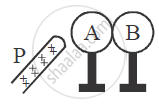
Two metallic spheres A and B kept on insulating stands are in contact with each other. A positively charged rod P is brought near the sphere A as shown in the figure. The two spheres are separated from each other, and the rod P is removed. What will be the nature of charges on spheres A and B?
Rewrite the following statement by selecting the correct option.
The S.I. unit of resistance is __________.
What are non-ohmic conductors? Give one exmaple. Draw a current-voltage graph for a non-ohmic conductor.
Ohm's law deals with the relationship between ______

Vinita and Ahmed demonstrated a circuit that operates the two headlights and the two sidelights of a car, in their school exhibition. Based on their demonstrated circuit, answer the following questions.
- State what happens when switch A is connected to:
a) Position 2
b) Position 3 - Find the potential difference across each lamp when lit.
- Calculate the current.
a) in each 12 Ω lamp when lit.
b) In each 4 Ω lamp when lit.
OR - Show, with calculations, which type of lamp, 4.0 Ω or 12 Ω, has the higher power.
A resistor is connected in a circuit with a voltage of 12 V and a resistance of 24 Ω. What is the current flowing through the resistor?
