Advertisements
Advertisements
प्रश्न
How should the two resistances of 2 ohms each be connected so as to produce an equivalent resistance of 1 ohm?
Advertisements
उत्तर
The two resistors of 2 Ω each should be connected in parallel combination to produce equivalent resistance of 1 Ω.
`1/R=1/R_1+1/R_2 `
`1/R=1/2+1/2`
or `1/R=2/2`
R=1 Ω
R = 1
Total resistance, R = 1 Ω
Resistance In parallel arangement is given by `
`1R=1R_1+1R_2`
`1R=12+12 or 1R=22 `
`R=1Ω `
APPEARS IN
संबंधित प्रश्न
What will be the change in the current if the potential difference is kept constant and the resistance of the circuit is made four times?
- It will remain unchanged.
- It will become four times.
- It will become one-fourth.
- It will become half.
Fill in the following blank with suitable words:
Resistance is measured in .............. The resistance of a wire increases as the length ..............; as the temperature ..............; and as the cross-sectional area .............. .
Calculate the electric field in a copper wire of cross-sectional area 2.0 mm2 carrying a current of 1 A.
The resistivity of copper = 1.7 × 10⁻⁸ Ω m
A wire has a length of 2.0 m and a resistance of 5.0 Ω. Find the electric field existing inside the wire if it carries a current of 10 A.
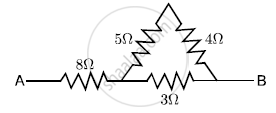
Calculate the effective resistance across AB?
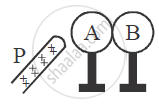
Two metallic spheres A and B kept on insulating stands are in contact with each other. A positively charged rod P is brought near the sphere A as shown in the figure. The two spheres are separated from each other, and the rod P is removed. What will be the nature of charges on spheres A and B?
A metal sphere is kept on an insulting stands. A negatively charged rod is brought near it, then the sphere is earthed as shown. On removing the earthing, and taking the negatively charged rod away, what will be the nature of charge on the sphere? Give reason for your answer.

Rewrite the following statement by selecting the correct option.
The S.I. unit of resistance is __________.
State the relation correlating the electric current flowing in a conductor and the voltage applied across it. Also, draw a graph to show this relationship.
Define ampere and volt with respect to Ohm’s law.
State microscopic form of Ohm’s law.
Define temperature coefficient of resistance.
Write a short note on superconductors?
Explain the equivalent resistance of a parallel resistor network.
The resistance of a nichrome wire at 0°C is 10Ω. If its temperature coefficient of resistivity of nichrome is 0.004/ °C, find its resistance of the wire at boiling point of water. Comment on the result.
An electronics hobbyist is building a radio which requires 150 Ω in her circuit, but she has only 220 Ω, 79 Ω, and 92 Ω resistors available. How can she connect the available resistors to get the desired value of resistance?
A heater of 220 V heats a volume of water m 5 mint time. A heater of 110 V heat in ten second. The resistance of the conductor is
For a continuous current flow through a conductor, what must be maintained across the ends of the conductor?
Which of the following describes the V-I relation for an Ohmic conductor?
