Advertisements
Advertisements
प्रश्न
How should the two resistances of 2 ohms each be connected so as to produce an equivalent resistance of 1 ohm?
Advertisements
उत्तर
The two resistors of 2 Ω each should be connected in parallel combination to produce equivalent resistance of 1 Ω.
`1/R=1/R_1+1/R_2 `
`1/R=1/2+1/2`
or `1/R=2/2`
R=1 Ω
R = 1
Total resistance, R = 1 Ω
Resistance In parallel arangement is given by `
`1R=1R_1+1R_2`
`1R=12+12 or 1R=22 `
`R=1Ω `
APPEARS IN
संबंधित प्रश्न
A low voltage supply from which one needs high currents must have very low internal resistance. Why?
What is Resistivity?
The graph between V and I for a conductor is a straight line passing through the origin.
- Which law is illustrated by such a graph?
- What should remain constant in a statement of this law?
The graph between V and I for a conductor is a straight line passing through the origin.
What should remain constant in a statement of this law?
How much energy is consumed when a current of 5 amperes flows through the filament (or element) of a heater having resistance of 100 ohms for two hours? Express it in joules.
A car bulb connected to a 12 volt battery draws 2 A current when glowing. What is the resistance of the filament of the bulb? Will the resistance be more same or less when the bulb is not glowing?
Show by a diagram how two resistors R1 and R2 are joined in parallel. Obtain an expression for the total resistance of the combination.
Fig. represents the circuit used for the verification of Ohm's law. Label the parts from A to F. state the function of each.
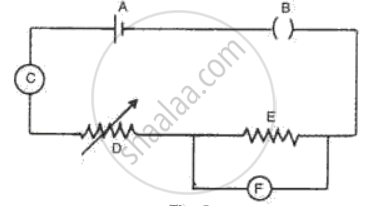
Draw a neat diagram for the verification of Ohm’s law by voltmeter-ammeter method. By another diagram show the relation between p.d. and current.
An ammeter placed in series with an electric radiator reads 0.5 amps and a voltmeter placed across it reads 230 volts. What is the resistance of the radiator?
SI unit of resistance is:
The variable resistance is called ____________.
Ohm's law deals with the relationship between ______
Consider a current carrying wire (current I) in the shape of a circle. Note that as the current progresses along the wire, the direction of j (current density) changes in an exact manner, while the current I remain unaffected. The agent that is essentially responsible for is ______.
Suppose there is a circuit consisting of only resistances and batteries and we have to double (or increase it to n-times) all voltages and all resistances. Show that currents are unaltered. Do this for circuit of Example 3.7 in the NCERT Text Book for Class XII.
Ohm's Law states that for a metallic conductor, the current flowing through it is directly proportional to the potential difference across its ends, provided that:
Which of the following is an example of a Non-Ohmic material?
What is the nature of the graph obtained when potential difference is plotted against current for an Ohmic conductor?
