Advertisements
Advertisements
प्रश्न
Show by a diagram how two resistors R1 and R2 are joined in parallel. Obtain an expression for the total resistance of the combination.
Describe the parallel connection of two resistors R1 and R2 using a diagram. Derive an expression for the equivalent resistance of the combination.
Advertisements
उत्तर

On applying Ohm's law to the two resistors separately, we further
Have
`"I"_1 = "V" / "R"_1`
`"I"_2 = "V" / "R"_2`
`"I" = "I"_1 + "I"_2 `
`"V"/"R" = "V"/"R"_1+ "V"/"R"_2`
`1/"R"=1/"R"_1+1/"R"_2`
संबंधित प्रश्न
When a 12 V battery is connected across an unknown resistor, there is a current of 2.5 mA in the circuit. Calculate the value of the resistance of the resistor.
In an experiment of verification of Ohm’s law following observations are obtained.
|
Potential difference V (in volt) |
0.5 | 1.0 | 1.5 | 2.0 | 2.5 |
| current I (in ampere) | 0.2 | 0.4 | 0.6 | 0.8 | 1.0 |
Draw a V-I graph and use this graph to find:
- the potential difference V when the current I is 0.5 A,
- the current I when the potential difference V is 0.75 V,
- the resistance in a circuit.
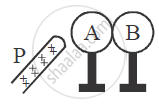
Two metallic spheres A and B kept on insulating stands are in contact with each other. A positively charged rod P is brought near the sphere A as shown in the figure. The two spheres are separated from each other, and the rod P is removed. What will be the nature of charges on spheres A and B?
Define Current density.
The variable resistance is called ____________.
State Ohm’s law? How can it be verified experimentally? Does it hold good under all conditions? Comment.
A current of 2amp flowing through a conductor produced 80 joule of heat in 10 sec. The resistance of the conductor is:-
The heat produced by a 100 w heater in 2 minute is equal to
Suppose there is a circuit consisting of only resistances and batteries and we have to double (or increase it to n-times) all voltages and all resistances. Show that currents are unaltered. Do this for circuit of Example 3.7 in the NCERT Text Book for Class XII.
What is the nature of the graph obtained when potential difference is plotted against current for an Ohmic conductor?
